

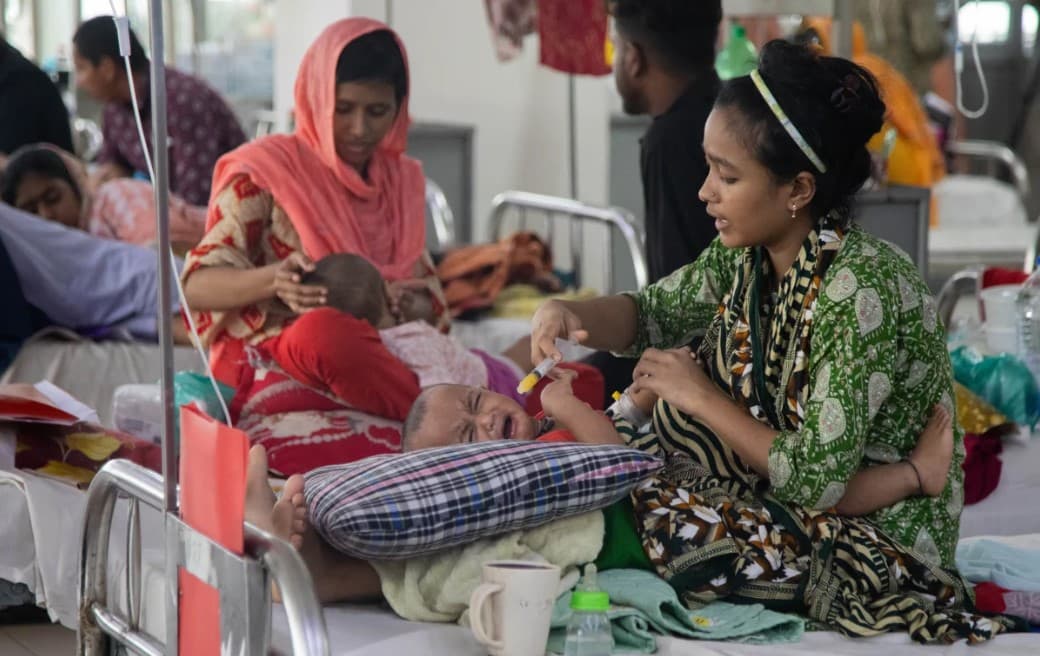
The Bangladesh measles outbreak is not simply a public health emergency. It is the most visible consequence of cascading institutional failures spanning a pandemic, a political transition, and a procurement breakdown. Over 500 children have died since March. More than 60,000 suspected cases have been recorded in just two months. Behind every number is a family like Al Amin's, who tried four times to vaccinate his daughter Akira and failed, not from negligence, but from a system that had quietly stopped functioning.
What Happened
Bangladesh is experiencing its worst measles surge in recent memory. Hospitals in Dhaka and other urban centers are overwhelmed, with parents reporting their children being turned away or treated in corridors. The virus, which spreads rapidly through respiratory droplets, is particularly lethal for unvaccinated children under five. Confirmed and suspected cases now exceed 60,000, with laboratory verification still pending for many. The government has cancelled Eid leave for medical workers and launched an emergency mass vaccination campaign. The death toll continues to rise.
Why This Matters Beyond the Headlines
This outbreak is the product of at least three overlapping failures compressing into one crisis window. First, the COVID-19 pandemic disrupted Bangladesh's door-to-door vaccination infrastructure between 2020 and 2022. Health workers who had previously reached rural families directly were pulled back, and some parents, already fearful of hospitals during the pandemic, stopped seeking routine jabs. Those immunity gaps were never systematically closed. Second, pockets of unvaccinated children had been accumulating since 2023, creating a dry-tinder population waiting for a spark. Third, a political transition following Sheikh Hasina's departure in 2024 introduced institutional disruption at exactly the wrong moment.
Political and Strategic Calculations
UNICEF has stated it held ten separate meetings with Bangladesh's interim government warning about risks tied to delays in vaccine procurement. The government changed how it purchased vaccines, introducing administrative delays that left supplies short. The interim administration disputes this, maintaining that procurement processes were unaltered and collaboration with UNICEF was consistent. This contested account matters enormously. If procurement reforms introduced bureaucratic friction during a vulnerability window, it represents a governance failure with measurable human cost. Political transitions are chronically dangerous periods for public health infrastructure precisely because institutional continuity breaks down. Bangladesh is a case study in what happens when health system resilience is not ring-fenced from political disruption.
Economic and Security Impact
Bangladesh's healthcare system was already operating under strain. The outbreak now threatens to deepen inequality in access to care. Poor families, as one epidemiologist noted, delay seeking hospital treatment until conditions become critical, both because of cost and distance. Urban hospitals absorbing rural overflow are being pushed toward collapse. The economic cost of the outbreak extends beyond healthcare spending. Worker productivity, school attendance, and caregiver time lost to illness carry compounding effects on a lower-middle-income economy. For a country rebuilding its political credibility after a turbulent transition, a visible child mortality crisis also carries reputational weight with international donors and development partners.
Global Reactions and Diplomatic Signals
UNICEF has deployed field teams to triage and isolate incoming cases at overwhelmed facilities. International attention has sharpened, particularly because the outbreak follows measles resurgences in multiple low-and-middle-income countries where COVID disrupted vaccination schedules. Bangladesh's crisis is a regional warning signal. South Asia's high population density, cross-border movement, and uneven healthcare infrastructure make it structurally vulnerable to exactly this kind of accelerant event. Global health agencies are watching whether the emergency vaccination campaign, launched in April, can generate sufficient herd immunity before Eid population movements disperse infection further.
What Happens Next
The government expects infections to decline within weeks as vaccine-induced antibodies develop. That timeline is medically plausible but depends on whether Eid travel patterns amplify transmission before immunity takes hold. Longer term, Bangladesh needs a structural audit of how COVID-era vaccination gaps were allowed to persist, and what procurement safeguards must exist during future political transitions. The deeper question is whether this crisis becomes a reforming moment or a forgotten emergency. Children like Akira deserve the former.
Conclusion
Bangladesh's measles outbreak is a preventable tragedy assembled from predictable parts: pandemic disruption, institutional inertia, political transition risk, and supply chain failure. The children who died were not failed by any single decision but by a system that accumulated fragility silently. Globally, this is a reminder that measles, a vaccine-preventable disease eliminated in many countries, remains lethal wherever governance and public health infrastructure fall out of sync. The cost of that misalignment is counted in children.