

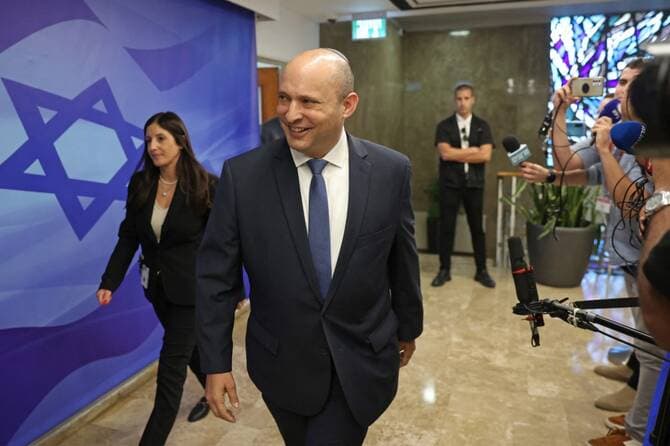
A former Israeli prime minister has publicly acknowledged that Israel smuggled Starlink internet receivers into Iran with the goal of helping anti-government protesters maintain access to communications during periods of state-imposed internet blackouts.
Naftali Bennett, who served as prime minister from 2021 to 2022, made the admission on Tuesday while speaking to an audience at the JNS International Policy Summit in Jerusalem. His remarks represent one of the most candid public statements by a senior Israeli figure on covert operations targeting Iran's domestic stability.
Bennett Reveals the Covert Starlink Operation
Speaking at the Jerusalem summit, Bennett said he had personally initiated a programme involving the acquisition and delivery of satellite internet devices into Iranian territory.
"I initiated a process of acquiring and smuggling into Iran tens of thousands of Starlink receptors that would allow continuity of the internet and social networks."
The devices, produced by Elon Musk's SpaceX under the Starlink brand, provide satellite-based internet connections that bypass conventional ground-level infrastructure. Iran has previously accused both Israel and the United States of smuggling the devices into the country to undermine its national security. While Starlink is not licensed to operate in Iran, Musk has previously stated that the service is active there.
Bennett said the intention behind the operation was to give protesters the tools to coordinate their activities and, ultimately, to bring down the Iranian government.
Bennett Blames Netanyahu Government for Abandoning the Plan
Despite initiating the programme, Bennett was pointed in his criticism of the current Israeli government's decision not to follow through on the groundwork he claims to have laid.
"Unfortunately, the current incompetent Israeli government stopped doing that. And when the protest happened, that infrastructure was not there."
His remarks carry a clear political edge. Bennett leads a right-wing opposition party and is among several politicians positioning themselves to replace Netanyahu ahead of an Israeli election due by October. His decision to go public with the details of the operation appears designed in part to draw a contrast between his own approach to Iran and what he characterises as the current government's failure to act.
Netanyahu's office did not immediately respond to questions about Bennett's remarks. SpaceX was not available for comment outside United States business hours.
Iran's History of Internet Shutdowns
The context behind Bennett's remarks is significant. Iranian authorities have repeatedly shut down public internet access during periods of civil unrest, using connectivity blackouts as a tool to limit the organisational capacity of protesters and restrict the flow of information reaching the outside world.
Such shutdowns occurred during deadly nationwide protests in January and continued throughout the period covering the US and Israeli war with Iran that began at the end of February. Reuters has previously reported that some Iranians turned to Starlink during these blackouts, suggesting the devices were already finding their way into the hands of citizens seeking to bypass state censorship.
The scale of Iran's internet restrictions has made satellite-based connectivity a particularly valuable asset for those seeking to organise or communicate beyond the reach of government controls, which is precisely the vulnerability that Bennett said his programme was designed to exploit.
Bennett's Broader Vision for Toppling Iran's Government
Beyond the Starlink operation, Bennett used his appearance at the Jerusalem summit to outline a wider strategic ambition. He said that if he returned to office, he would pursue an active policy of undermining the Iranian government with the explicit goal of bringing it down.
Such a policy, he indicated, would not necessarily rely on direct military action. Instead, it could involve a range of measures falling short of open warfare, including economic pressure and industrial sabotage targeted at key elements of Iran's infrastructure and capacity.
His comments reflect a school of thought within Israeli political circles that views regime change in Tehran as a more sustainable long-term objective than repeated military strikes on individual targets. Whether that approach commands broad support within the Israeli security establishment remains a matter of ongoing debate.
A Public Admission With Political Consequences
Bennett's willingness to discuss a covert operation of this nature in a public forum is itself notable. Intelligence operations of this kind are rarely acknowledged openly by serving or former officials, and his decision to do so at a high-profile policy summit will draw scrutiny both at home and abroad.
For Iran, the remarks are likely to harden already deep suspicions about Israeli involvement in domestic unrest. For Israel, the disclosure opens a debate about what its covert strategy toward Tehran should look like, and who is best placed to lead it.