

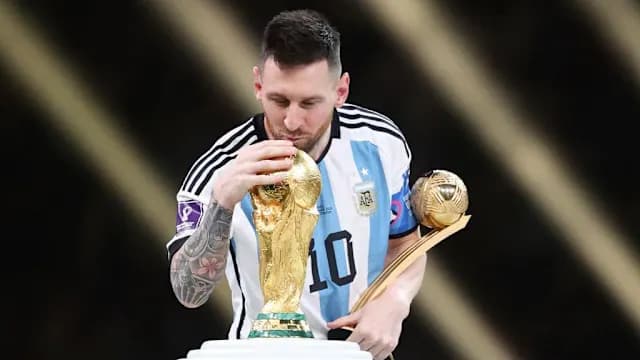
If Argentina are to become the first nation to successfully defend their World Cup crown since 1962, and just the third ever to do so, then Lionel Messi Evolution will have been at the centre of it. At his sixth World Cup, a joint record alongside Portugal's Cristiano Ronaldo and Mexico's Guillermo Ochoa, the 39-year-old has scored eight goals and provided three assists, leading the Golden Boot race alongside France striker Kylian Mbappe.
But the global audience watching this tournament has been seeing a very different Messi from the one who made his Barcelona debut in 2003. He has been creating more while moving less. He has walked 47 per cent of the distance he has covered, the highest percentage of any outfield player at the tournament. He averages just 8.2km per 90 minutes, the shortest distance of all Argentina outfield players to have featured for 20 or more minutes. His sprint count has fallen to 2.7 per match, compared with 5.3 just four years ago.
Yet he has had 33 shots and created 21 chances, the most combined total of 54 since Diego Maradona in 1986.
Argentina face England in the semi-finals on Wednesday at Atlanta Stadium. England will need to do something only Poland have managed across Messi's last 15 World Cup appearances: stop him from scoring or assisting. He has 16 goals and seven assists in those 15 games.
From Right Wing to False Nine: The Guardiola Years
Since that 16-year-old made his Barcelona debut in a friendly against Jose Mourinho's Porto, playing on the right, dribbling and cutting inside, Messi has reinvented himself at least five times. When Ronaldinho first saw him train, he said simply: "He will be the best." Two years later, in August 2005, Messi announced himself to the wider world in the Joan Gamper Trophy against Juventus. Fabio Capello, the Juventus manager, was reportedly so startled by the 18-year-old that he tried to sign him.
By the time Messi was 21, then Barcelona manager Frank Rijkaard had a clear view of what the team needed from him.
"Right in the centre of things. The more he touches the ball, the better for the side."
When Pep Guardiola took charge in 2008, the right side of the pitch was still Messi's corridor. But Guardiola moved him away from the wing initially for defensive reasons. Messi did not track back and the full-back struggled. The Catalan manager knew, however, that Messi would eventually end up at the centre of operations regardless, and built the team around that inevitability.
The pivotal moment came on 2 May 2009 at the Santiago Bernabeu. Guardiola placed Messi at the tip of the forward formation without the responsibilities of a traditional striker. Samuel Eto'o went right, Thierry Henry went left, and Messi was given one instruction: drop, receive, decide. By full-time, it was 6-2. The false nine was reborn.
When Messi dropped between the lines, Real Madrid's centre-backs faced an impossible choice: follow him and leave a hole, or hold and give him space. Neither worked. With Xavi, Andres Iniesta and Yaya Toure behind him, every decision the opposition made was the wrong one. Guardiola repeated the experiment weeks later in the Champions League final against Manchester United. Messi scored with his head.
Between 2011 and 2013, he scored 96 goals across 69 La Liga matches. He won the Ballon d'Or in 2009, 2010, 2011, 2012, 2015 and 2019, eventually accumulating eight. The first arrived when he was 22. The most recent when he was 36.
"With Guardiola I learned an enormous amount," Messi told journalist Juan Pablo Varsky in 2024. "I started to understand spaces, ball retention, how the game really works."
The Engine of a Team: Messi Without His Midfield
When Xavi left Barcelona in 2015 and Iniesta followed three years later, the dynamic shifted considerably. Messi had always been the decisive player. Now he was being asked to be the entire engine. The midfield that had been his safety net was gone, and he responded by evolving again.
The false nine became the enganche, dropping deeper to organise and initiate as well as finish. Assists began to rival goals. In the 2019-20 season he registered 22 assists alongside 25 goals in 33 La Liga games. His first season at Paris Saint-Germain confirmed the shift conclusively: 11 goals and 15 assists in 34 games across all competitions, more assists than goals for the first time at club level in his career.
One Argentine analyst described it plainly: a goalscorer who became an Iniesta.
The Captain Argentina Finally Needed
Running alongside the tactical evolution was a longer and more painful story: the question of who Messi was for Argentina. He became captain in August 2011. Then came the defeats. The 2014 World Cup final, lost to Germany in extra time in the Maracana. The 2015 Copa America final, lost on penalties to Chile. The 2016 Copa America final, lost on penalties to Chile again. Three finals in three years, and after the last one he quit, before returning a changed figure.
At the 2019 Copa America, eliminated controversially by hosts Brazil, Messi walked into a press conference and strongly criticised the South American football confederation. This was not the player who had once retreated into silence under the weight of expectation. This was a leader who had decided to stop being defined by what he had not won.
The Copa America 2021 was the release. Argentina beat Brazil in the Maracana final, ending a 28-year wait for a major title. The pre-match team talk Messi gave moved the dressing room to tears.
The 2022 World Cup brought a synthesis of everything that had come before. The sprint past Josko Gvardiol against Croatia, the 2009 winger reappearing for one extraordinary moment. The quarterback precision in the final against France, the ghost-run to force the rebound for Argentina's third goal, the penalties converted when everything was on the line.
The Veteran Who Walks and Still Sees Everything First
"Football changed a lot," Messi told Zinedine Zidane in a 2023 interview. "The way of playing, the systems. The game today is much more tactical and physical than before. Before, you found more spaces."
At Inter Miami, across the 2024 Copa America, and now at this World Cup, Messi walks more than he runs. Critics once used this against him. Now it reads as mastery. He is reading the game, conserving energy for the moments that matter most.
His childhood idol Pablo Aimar once said: "The last Messi is always the best Messi." He is probably still right.
What Messi has achieved across two decades is not simply an accumulation of trophies and statistics. It is a re-imagination of what a footballer can be at every stage of a career. The point is not how good he is. The point is how many times he has had to become someone completely new.