

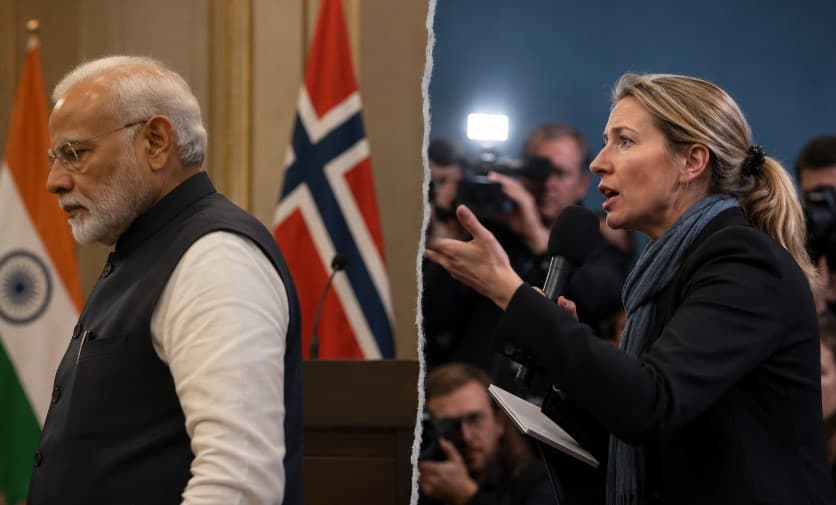
When PM Modi skipped reporter questions in Oslo, a Norwegian journalist triggered a diplomatic firestorm - and exposed a fault line between two very different definitions of freedom.
What Happened
It began with a skipped press appearance. When Prime Minister Narendra Modi wrapped up his bilateral meeting with Norway's Prime Minister in Oslo on May 18, reporters gathered for the customary joint press conference - only to watch Modi depart without fielding a single question. For a journalist in the world's most press-free country, the moment was impossible to ignore.
Norwegian journalist Helle Lyng captured the exit on video and shared it across social media with a pointed observation: Norway sits at #1 on the 2026 World Press Freedom Index. India, she noted, sits at 157th out of 180 countries. "Why don't you take some questions from the world's freest press?" a voice is heard calling out in the clip as Modi walks away.
"Norway ranks #1 in press freedom. India ranks 157th. Why should we trust India when its leader runs from questions?" - Helle Lyng, Norwegian journalist, Oslo, May 18, 2026
What happened next was remarkable: rather than letting the moment pass, the Indian Embassy in Oslo responded directly on X and extended Lyng a personal invitation to the MEA press briefing at her hotel. She accepted. The stage was set for one of the most charged diplomatic exchanges of Modi's five-nation Europe tour.
Key Numbers
157th
India's rank on the 2026 World Press Freedom Index (out of 180 countries)
#1
Norway's rank - 10 consecutive years at the top
43
Years since an Indian PM last visited Norway before this trip
200+
TV channels MEA cited in Delhi alone as evidence of media freedom
Timeline of Events
May 18 · PM arrives OsloModi's bilateral meetings with Norway's PM. Joint appearance ends - Modi exits without press questions.
May 18 · X Post goes viralLyng posts exit video, cites India's #157 ranking vs Norway's #1. Post spreads widely.
May 18 · Embassy invites LyngIndian Embassy publicly responds on X, invites Lyng to MEA briefing at her hotel.
May 18 Evening · The clashMEA briefing turns combative. Sibi George's "ignorant NGOs" quote goes viral globally.
May 19 · Opposition reactsRahul Gandhi reposts Lyng's video with sharp commentary. Domestic debate intensifies.
The Challenge
At the MEA briefing, Lyng did not come with soft questions. She arrived with a pointed agenda - pressing Indian officials on press freedom rankings, minority rights, human rights records, and the fundamental question of why India deserves international trust at all given its standing in global indices.
Norwegian Media - The Accusations
1. Press Freedom: "India ranks 157th out of 180 on the World Press Freedom Index - a 'very serious' category. How can a country that low in press freedom claim to be a thriving democracy?"
2. Accountability: "Why does Prime Minister Modi refuse to take unscripted questions from press? What is there to hide?"
3. Trust Deficit: "Why should the world trust India on human rights, minority rights, and democratic values when its own record is deeply questioned by international bodies?"
4. Confrontational journalism: Lyng later defended her style on X, calling journalism "sometimes confrontational" and saying it was her duty to interrupt to get "answers, not just talking points."
It was not merely a press conference - it was, by most accounts, a pointed audit of India's international democratic credentials delivered in real time, in the most press-free country on earth.
MEA Fires Back
MEA Secretary (West) Sibi George stepped up to the podium and what followed was anything but diplomatic boilerplate. He defended India's constitutional framework with conviction - but also, by most accounts, with visible agitation, discarding the careful language of professional diplomacy for something rawer and more combative.
MEA Official Response - Key Arguments
"We are proud to be a democracy." George anchored his defence in India's Constitution - arguing it guarantees fundamental rights to every citizen and provides legal remedies for any violations.
Women's suffrage as evidence: India gave women equal voting rights in 1947 - at independence - a milestone, George argued, that preceded many Western democracies by decades.
"The right to vote and change governments - that is the strongest human right." He positioned electoral democracy as the supreme indicator of democratic health, above press metrics.
"Go to court." When pressed on rights violations, George's response was unambiguous: citizens have judicial recourse, and that access is itself proof of a functioning democracy.
"Ignorant NGOs": His most viral moment - dismissing international press freedom rankings as products of "godforsaken, ignorant NGOs" whose reports people read before asking uninformed questions. "Delhi alone has 200+ TV channels," he argued, presenting media volume as equivalent to media freedom.
Global credibility: He cited India's role during the Covid-19 pandemic - vaccine supply, humanitarian outreach, global diplomacy - as evidence of why countries trust India.
"They read one or two reports from some godforsaken, ignorant NGOs and then come and ask questions."- Sibi George, MEA Secretary (West), Oslo Press Briefing, May 18, 2026
The comments spread rapidly across Indian social media, with government supporters praising George's assertiveness as a long-overdue pushback against what they characterised as Western condescension toward India's democratic record.
Opposition Reacts
Back home, India's political opposition moved swiftly to frame the episode not as a diplomatic victory but as an embarrassing exposure. Leader of the Opposition Rahul Gandhi reposted Lyng's original video on X with a pointed commentary.
Opposition - Rahul Gandhi's Response
"When there is nothing to hide, there is nothing to fear. What happens to India's image when the world sees a compromised PM panic and run from a few questions?"
Gandhi's framing positioned Modi's exit not as a scheduling decision but as evidence of unwillingness to face independent scrutiny - a charge that resonated with the domestic press freedom community and opposition circles who have long argued that the PM's media access has been systematically restricted to controlled formats.
Civil society organisations and journalist groups noted the irony: the most substantive international questioning of India's press environment in recent memory happened not in India, but in Oslo - and not with Indian journalists, but with a Norwegian reporter who had no institutional constraints on her line of questioning.
Fact-Check
The clash produced competing claims about India's democratic credentials. Here is a breakdown of what holds up to scrutiny:
Claim | Source | Verdict | Context |
|---|---|---|---|
India gave women voting rights in 1947 - before many Western nations | MEA | True | India's Constitution granted universal suffrage at independence. France gave women the vote in 1944; Switzerland only in 1971. The claim is historically accurate. |
India has 200+ TV channels - proof of media freedom | MEA | Misleading | Channel volume ≠ editorial independence. RSF's index measures journalist safety, media ownership concentration, legal harassment - not quantity of broadcasters. Plurality can coexist with partisan capture. |
India ranks 157/180 on the 2026 World Press Freedom Index | RSF / Lyng | Accurate | India fell 6 places from 151st in 2025 to 157th in 2026. RSF cites judicial harassment of independent media, defamation laws used against journalists, and media ownership by government-aligned oligarchs. |
India's court system guarantees rights - "go to court" | MEA | Partial | India's Supreme Court is constitutionally independent and has delivered landmark judgements. However, RSF and international observers note that sedition, UAPA, and defamation laws are increasingly used to preemptively silence journalists before any court hearing. |
Press freedom rankings are products of "ignorant NGOs" | MEA | Misleading | RSF (Reporters Without Borders) uses a mixed-methods index combining expert assessment, field reporting, and incident data across 180 countries. It is a widely cited measure referenced by the UN, EU, and global media organisations. |
Political Analysis
At its core, the Oslo clash exposed something deeper than a diplomatic spat: two irreconcilable definitions of democracy were talking past each other.
The MEA's framework is procedural democracy - elections, constitutional rights, judicial access, women's suffrage. By these metrics, India's democratic credentials are substantial and genuinely impressive for a nation of 1.4 billion people, rooted in universal adult franchise from day one.
The Norwegian journalist's framework is liberal democracy - press freedom, governmental accountability to independent media, the ability of citizens and journalists to question those in power without institutional fear. By these metrics, India's standing has deteriorated, and international observers have documented it with specificity.
Both frameworks have legitimate foundations. The problem is that each side treated its definition as the complete one - and neither acknowledged the validity of the other's concern. George's "200 TV channels" defence does not address editorial independence. Lyng's press freedom ranking does not capture the complexity of governing a democracy of India's scale and diversity.
What made the episode significant - and viral - was not the content of the arguments but their setting and tone. A senior Indian diplomat, abroad, visibly agitated, dismissing international indices as the work of "ignorant NGOs" is not the image a diplomatically confident nation typically projects. It suggested the questions landed harder than the official response let on.