

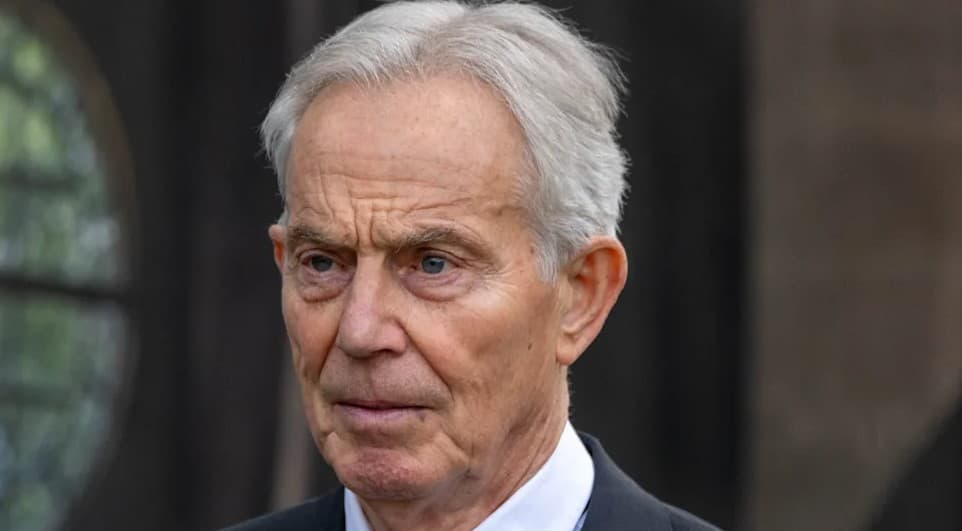
Tony Blair's 5,600-word essay targeting Keir Starmer's Labour government landed this week not as commentary but as a strategic intervention timed, precise, and aimed at reshaping a party that appears to be drifting toward electoral collapse before it has finished its first term.
What Happened
Blair published a sweeping critique of the Starmer government, singling out workers' rights legislation, above-inflation minimum wage increases, the phasing out of North Sea oil and gas, and the National Insurance hike on employers as policies that had handed "headwinds not tailwinds" to British business. He stopped short of calling for Starmer's removal but made clear the problem was structural, not personal.
Why This Matters Beyond Headlines
This is not merely one former prime minister criticising another. Blair governed with three consecutive majorities and defined centrist Labour for a generation. When he writes that the government lacks a "worked-out coherent plan for the country in a fast-changing world," he is diagnosing something deeper than poor messaging: a fundamental absence of governing philosophy.
The timing matters. Labour suffered serious losses in May local elections. Five ministers resigned. A leadership contest is now widely anticipated. Blair's essay arrives not to spark that contest but to frame the terms on which it should be fought ensuring any successor inherits a centrist, growth-oriented platform rather than a leftward lurch.
Political and Strategic Calculations
Blair is playing a longer game. By explicitly warning against forcing Starmer out before a "policy debate," he insulates himself from accusations of destabilising the government while simultaneously making that policy debate unavoidable. His target is not just Starmer but candidates like Andy Burnham, the Greater Manchester mayor positioning himself as a populist alternative, whom Blair indirectly mocked for blaming "40 years of neo-liberalism."
The essay signals that Blair intends to be the ideological anchor of any post-Starmer Labour rebuild. The "Radical Centre" framework he proposes welfare reform, pro-business regulation, controlled immigration, artificial intelligence investment is Blair 1.0 repacked for 2026 conditions.
Economic and Policy Impact
Blair's economic critique has substance. The employer National Insurance increase, introduced in the last budget, drew immediate business backlash. The Employment Rights Bill has alarmed smaller employers over hiring costs. These are not trivial concerns in an economy still managing post-pandemic debt loads and navigating post-Brexit trade friction.
His observation that the government appeared to raise taxes primarily to fund welfare spending at a moment when public appetite for welfare growth is low identifies a genuine political trap. Labour campaigned on growth but has governed, in part, with redistribution tools that have suppressed business investment sentiment.
Global Reactions and Diplomatic Signals
The international dimension is understated but present. Blair acknowledged Britain has lost from Brexit but warned that simply rejoining the EU is not a viable strategy from a position of economic weakness. This carefully hedged position distances him from both hardline Remainers and Brexit defenders, leaving space for a pragmatic realignment agenda with Europe that stops short of formal membership.
What Happens Next
Three scenarios are credible. First, Starmer survives, absorbs some Blair-aligned policy corrections, and attempts a soft relaunch. Second, Starmer falls before the next election, triggering a contest in which Blair's Radical Centre framework shapes the winning candidate's platform. Third, Labour fractures further, with the left and centre fighting a public ideological war that hands the next election to the Conservatives or, more dangerously, to Reform UK.
The Makerfield by-election next month will serve as a live stress test. If Reform performs strongly and Burnham wins comfortably, the party's centre-left fault line becomes impossible to paper over.
The deeper lesson Blair is trying to teach is one he learned the hard way: governing parties that lose economic credibility rarely recover it mid-term. The question for Labour is not who leads it, but whether anyone is yet willing to make the hard choices that credibility requires.