

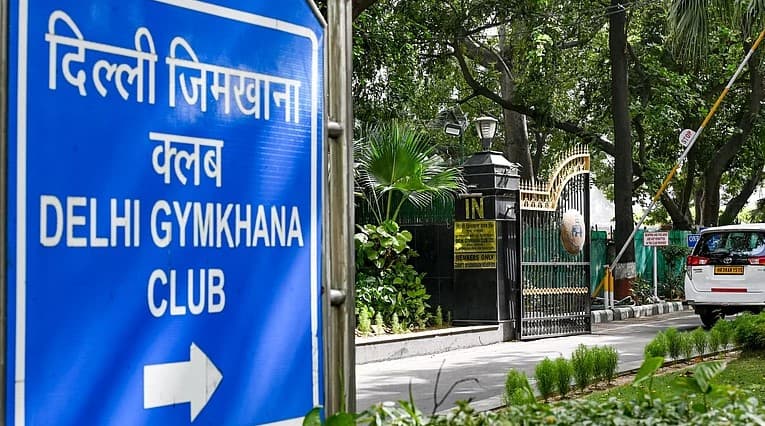
The Delhi Gymkhana Club has outlasted an empire. Founded in 1913 as the Imperial Delhi Gymkhana Club, it watched the British leave, survived seven decades of Congress dominance, and quietly endured as the social nucleus of independent India's establishment. Now, the Delhi Gymkhana Club eviction ordered by the Modi government may end what colonial rule could not. Understanding why requires looking well past the government's stated rationale.
What Happened
India's Ministry of Housing and Urban Affairs issued an eviction notice on May 22, ordering the club to vacate its 27.3-acre site at 2, Safdarjung Road by June 5. The notice invokes Clause 4 of the original 1918 perpetual lease deed, which permits the government to reclaim the land if required for public purposes. The government's order cited national security and defence infrastructure requirements, describing the premises as located in a "highly sensitive and strategic area." The club's management called an emergency meeting and announced it would challenge the order in court.
Why This Matters Beyond Headlines
The official justification strains credibility on examination. There is no previous record of government plans or attempts to redevelop the lands for official purposes. The club occupies a prime site in Lutyens' Delhi, next door to the Prime Minister's official residence, and has long been coveted by the BJP.
More critically, the government has a documented track record of changing its stated objectives when seeking to seize the club. One of its earlier stated goals was ending the club's exclusivity, but this was quietly dropped once BJP officials had been appointed to membership by the club's new ruling panel. The pattern reveals a strategy of institutional capture dressed in procedural language.
For more than a century, the Delhi Gymkhana Club existed as far more than a sports or social institution. Hidden behind manicured lawns and colonial architecture in Lutyens' Delhi, it became a symbol of power, privilege and influence, a space where bureaucrats, generals, diplomats and industrialists shaped networks over drinks and tennis.
The membership waiting list ran approximately 37 years. This meant membership reflected the elites of an older India, with civilian membership dominated by Congress-era figures. Members of Modi's BJP, which came to power in 2014, languished on the waiting list until the government seizure from 2021. Access to the club was, in essence, access to a rival network.
In early 2021, an official from India's Ministry of Corporate Affairs arrived at the Gymkhana accompanied by police, bureaucrats and media, announcing a government takeover. Officials cited a court order alleging years of financial mismanagement and abuse of power by elected committees. By April 2022, the NCLT formally allowed the central government to nominate 15 persons as directors on the club's general committee. The financial mismanagement argument served as legal scaffolding for a political reorganization.
Economic and Security Impact
Ever since the BJP came to power in 2014, the club, adjacent to the Prime Minister's house on Lok Kalyan Marg, has been under threat. The club is run on eternally leased land, which the government disputes, making it legally easier to reclaim.
The site itself represents some of the most valuable real estate in South Asia. Twenty-seven acres inside Lutyens' Delhi, adjacent to the Prime Minister's residence, carries extraordinary strategic and monetary weight. The land will vest with President Droupadi Murmu upon reclamation, framing the takeover as a constitutional and institutional act rather than a partisan maneuver.
Global Reactions and Diplomatic Signals
The eviction order triggered a sharp political exchange. Congress alleged the land was being reclaimed to expand the Prime Minister's official residence, while BJP hit back by pointing to the size of opposition leaders' own government-allocated properties. Internationally, outlets including Bloomberg and the Financial Times covered the story as a window into Modi's broader reshaping of India's institutional landscape. The diplomatic and business communities in Delhi, many of whom hold club memberships, are watching closely.
What Happens Next
The club's management has signaled a legal challenge. A 2024 appellate court ruling maintained that the club could only be seized as a temporary measure and needed to be returned to members by June 2025, with members actively litigating to enforce that ruling. The courts are now the last contested terrain.
Three scenarios are plausible. First, the courts could stay the eviction, extending litigation for years while the political pressure continues. Second, the club capitulates and a new institutional identity emerges, effectively making it a government-adjacent facility. Third, a negotiated settlement redraws membership terms while preserving the physical site. None of these outcomes returns the Gymkhana to its prior independence.
Conclusion
The Delhi Gymkhana Club eviction is not, at its core, a story about land or defence infrastructure. It is a story about who controls the informal architecture of Indian power. The club survived British departure and Congress hegemony because it adapted. What it could not adapt to was becoming, in the BJP era, a visible symbol of old-money networks that the ruling party sought to either enter or dismantle. The battle for 27 acres in Lutyens' Delhi is, in reality, a battle over whose India gets remembered in the buildings that remain.