

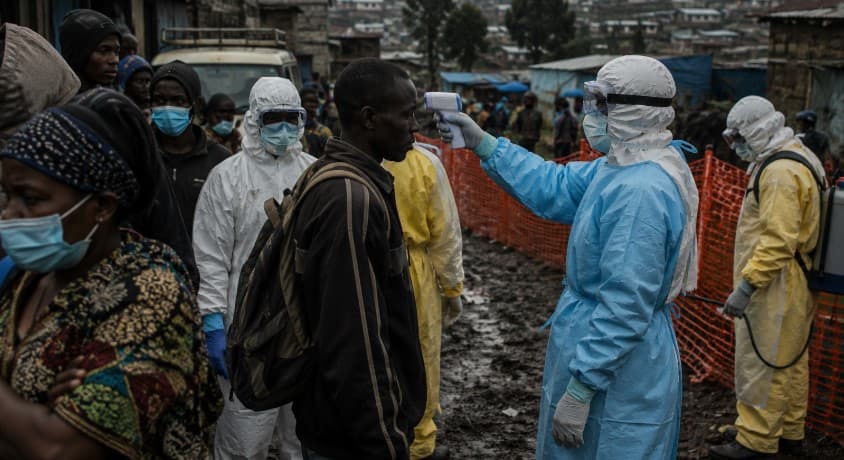
The word "pandemic" carries enormous geopolitical weight. In May 2026, the Ebola outbreak in the Democratic Republic of Congo is forcing that word back into global policy conversations. With at least 131 confirmed deaths, over 513 suspected cases, confirmed spread to Uganda, and the World Health Organization declaring an international public health emergency, the question is no longer whether this outbreak is serious. The question is whether the systems designed to contain it can actually work this time.
What happened
The current outbreak is caused by the Bundibugyo virus, a distinct Ebola strain first identified in 2007. Unlike the Zaire strain responsible for the catastrophic 2014 to 2016 West Africa epidemic that killed over 11,000 people, Bundibugyo typically carries a lower fatality rate but has demonstrated capacity for rapid geographic spread. Cases have now emerged across eastern DRC including Ituri Province, Butembo, and the strategic city of Goma, a major urban and transport hub. Uganda has reported two confirmed cases and one death. An American doctor working in the country tested positive and is being evacuated for treatment in Germany.
Why this matters beyond the headlines
Ebola reaching Goma is the scenario that infectious disease planners have feared for years. It is a city of over one million people with an international airport, active conflict zones on its perimeter, and a humanitarian infrastructure already stretched by years of instability. The 2018 to 2020 North Kivu Ebola outbreak, which killed over 2,200 people, reached Goma briefly and was stopped only through aggressive response. This outbreak has now crossed that same threshold, and critically, it arrived without an approved vaccine for the Bundibugyo strain. The head of Africa CDC confirmed that no effective medicines or vaccines currently exist for this specific virus, which fundamentally changes the containment calculus.
Political and strategic calculations
The DRC government's messaging urging calm against growing geographic spread reveals a familiar tension in outbreak response: political optics versus epidemiological transparency. Governments in fragile states consistently underreport in early stages to avoid panic and economic fallout, which invariably allows the outbreak to deepen before full emergency protocols activate. The WHO's declaration of a Public Health Emergency of International Concern is significant precisely because it bypasses this domestic political hesitation and triggers international obligations, funding mechanisms, and coordinated response protocols. For neighboring Rwanda, tightening border screenings is both a practical and political signal of regional self-preservation.
Economic and security impact
Eastern DRC is one of the world's most mineral-rich corridors, with coltan, gold, and cobalt extraction feeding global technology supply chains. An uncontained outbreak in this region disrupts mining operations, supply logistics, and the already precarious security arrangements that keep extraction viable. International humanitarian organizations operating in eastern Congo face the dual burden of conflict exposure and now disease risk, complicating the foreign worker pipeline that keeps many NGO operations functional. The US Level 4 travel advisory, its highest severity level, and entry restrictions on non-citizens who have visited DRC, Uganda, or South Sudan within 21 days, will begin to ripple through aid supply chains, investment confidence, and airline routes within weeks.
Global reactions and diplomatic signals
The CDC's measured language about "relatively low" US risk sits in deliberate contrast to its travel restrictions and evacuation of American nationals. This is a standard risk-communication strategy designed to prevent domestic panic while triggering preparedness mechanisms. Nigeria's statement that it is "closely monitoring" the situation reflects a learned institutional memory from its near-miss during the 2014 outbreak, when rapid response in Lagos prevented a far larger catastrophe. The WHO has not declared a pandemic, which by its own definition requires sustained, widespread transmission in multiple countries. That threshold has not been crossed. Yet.
What happens next
The WHO has been explicit that the real case count may be significantly larger than reported, a warning grounded in the region's limited laboratory infrastructure and ongoing conflict disruptions. Three scenarios are plausible. First, aggressive contact tracing and community engagement contain the outbreak within eastern DRC within three to four months, similar to the 2017 DRC Ebola response. Second, Goma becomes a persistent transmission amplifier, seeding cases in neighboring Rwanda, Burundi, or Uganda at a scale that forces an international military-humanitarian response corridor. Third, a gap in airport screening or an undetected case chain carries the virus into a high-density transit hub, elevating international spread risk significantly. The absence of a Bundibugyo vaccine means scenario two or three would require entirely behavioral and logistical containment, with no immunization backstop.
The honest answer to whether this becomes a pandemic is: not yet, and possibly not at all. But the structural conditions that allowed previous outbreaks to spiral, institutional underreporting, vaccine gaps for variant strains, urban spread without containment infrastructure, and cross-border movement in conflict zones, are all present simultaneously. That confluence deserves far more global attention than it is currently receiving.