

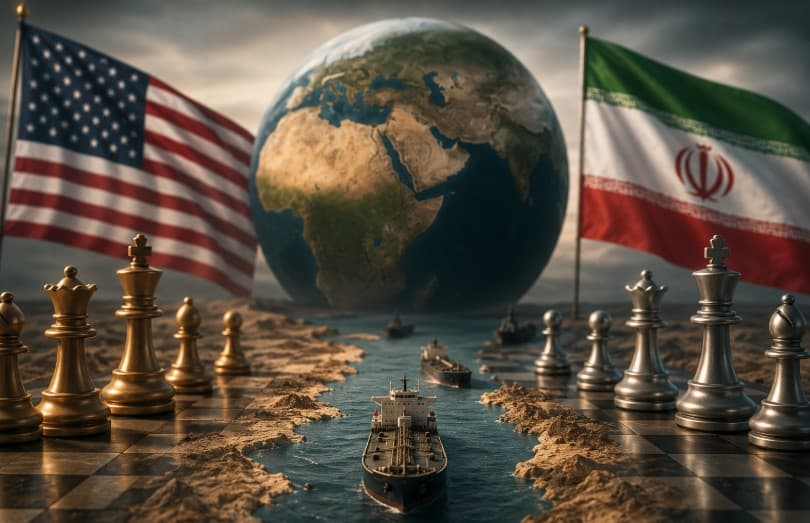
A tentative agreement between Washington and Tehran is taking shape, and its implications stretch well beyond the waterway at its center. The US-Iran deal 2025, if it materialises this week, would not simply end a military confrontation. It would reorder assumptions about American deterrence, Iran's strategic endurance, and the fragile geometry of Middle Eastern power that has been destabilised since late February.
The raw facts are worth stating briefly. Following US and Israeli strikes on Iran on 28 February, a war of attrition broke out across the Middle East. Iran retaliated, attacked US-allied Gulf states, and effectively closed the Strait of Hormuz, the chokepoint through which approximately one-fifth of global oil and liquefied natural gas flows. After a ceasefire in early April, the US established a naval blockade of Iranian ports. Now, both sides appear close to a 60-day extension of that ceasefire, a plan to reopen the strait, and a framework for further negotiations on Iran's nuclear programme.
What Happened
Secretary of State Marco Rubio, speaking from New Delhi, acknowledged a "pretty solid" proposal was on the table as of Monday. He was careful to hedge: communications with Iran's Supreme Leader Mojtaba Khamenei, reportedly injured in an Israeli strike that killed his father, are complicated by his undisclosed location. That detail alone reveals how much structural damage this conflict has already inflicted on the Iranian state's command apparatus.
President Trump, characteristically, sent mixed signals first suggesting a deal was imminent, then instructing negotiators "not to rush." This tension between urgency and leverage is not accidental. It is a negotiating posture, one designed to extract maximum concessions before any agreement is formalised.
Why This Matters Beyond the Headlines
The proposed deal is not a final settlement. It deliberately defers the hardest questions: the scope of sanctions relief, the fate of frozen Iranian funds estimated in the tens of billions of dollars, and the precise terms under which Iran would curtail its nuclear ambitions. At the start of the conflict, Iran held roughly 440 kilograms of uranium enriched to 60% purity, a relatively short technical step from weapons-grade material.
This architecture of deliberate ambiguity serves both parties. For the US, it allows Trump to claim a diplomatic victory without fully resolving the nuclear file. For Iran, it provides economic breathing room without formally abandoning a programme that functions as its most credible deterrent. Both sides are essentially buying time, which means the structural tension that ignited this conflict remains unresolved.
Political and Strategic Calculations
The deal has exposed a visible fracture within Trump's own Republican coalition. Senator Ted Cruz called any agreement a "disastrous mistake." Senator Roger Wicker, who chairs the Armed Services Committee, argued a 60-day ceasefire would waste the gains of Operation Epic Fury. Senator Lindsey Graham questioned the strategic logic of a war that ends without a dominant outcome.
Trump's response was characteristically blunt: he does not listen to "the losers." But the political pressure these figures represent is real. Any deal that is perceived as lenient will face fierce domestic opposition, potentially constraining Trump's room to offer Iran meaningful economic concessions in later rounds of negotiation.
From Tehran's side, Iran's foreign ministry admitted the two sides were simultaneously "very close and very far." This is not diplomatic theatre. It reflects genuine internal divisions within the Iranian leadership about whether to accept a framework that constrains the nuclear programme in exchange for sanctions relief or whether to hold out for more.
Economic and Security Impact
The strait's closure sent oil prices sharply higher in the weeks following the conflict's outbreak. The prospect of a deal reversed some of that pressure on Monday, with Asian equity markets rising and crude prices falling on ceasefire hopes. But shipping industry analysts are cautioning against immediate optimism. Lars Jensen, the chief executive of Vespucci Maritime, noted that even after a signed agreement, global supply chains could take months to return to their pre-crisis configuration. Insurers, ship operators, and cargo owners will remain cautious until the political framework is proven durable.
The economic asymmetry here is striking. Iran suffers from the blockade directly and immediately. The US and its allies bear costs through energy price volatility and disrupted trade routes, but those costs are distributed across a broader base. This gives Washington structural leverage in the negotiation, but also makes it easier for Tehran to calculate that American political will is finite.
Global Reactions and Diplomatic Signals
India's role as Rubio's backdrop for these statements is worth noting. New Delhi has maintained economic relationships with both Washington and Tehran, and has a direct strategic interest in the strait's reopening given its dependence on Gulf energy imports. The choice of venue signals that the US is managing the optics of this negotiation carefully framing it as a regional stabilisation effort rather than a bilateral concession.
Other powers are watching closely. Gulf states that absorbed Iranian retaliatory strikes have their own calculations about what a US-Iran agreement means for their security guarantees from Washington. A deal that leaves Iran's nuclear potential intact, even partially constrained, will prompt renewed discussions about independent security arrangements across the Gulf Cooperation Council.
What Happens Next
Three scenarios are plausible. In the most optimistic, a 60-day ceasefire holds, the strait reopens, and both sides use the window to negotiate a more comprehensive agreement on nuclear limits and sanctions relief. Oil prices stabilise, and the region enters a fragile but functional equilibrium.
In a second scenario, the deal is announced but implementation falters. Verification disputes, domestic political opposition in both capitals, or a resumption of proxy hostilities could unravel the framework within weeks. Markets would react harshly.
In the third and most dangerous scenario, no deal is reached this week, the blockade intensifies, and Iran calculates that its best option is to accelerate rather than constrain its nuclear programme. At that point, the entire diplomatic architecture collapses, and the conflict enters a new and harder phase.
Conclusion
A 60-day ceasefire is not peace. It is a pause in a contest whose underlying logic has not changed. The US wants an Iran that cannot build a nuclear weapon and cannot close the world's most critical energy corridor. Iran wants sanctions relief, frozen funds, and a security guarantee against regime change. These objectives are not fully compatible.
What the prospective deal represents is the best available interim arrangement, not a resolution. Its value lies precisely in buying time for both sides to test whether a more durable agreement is achievable and to prepare for the possibility that it is not. The world will watch the Strait of Hormuz very carefully in the weeks ahead. What flows through it, or doesn't, will tell us more about the real state of this negotiation than any statement from New Delhi or Truth Social.