

Introduction
In a startling discovery that bridged the gap between living memory and distant history, a World War II-era bomb was recovered from the bed of the Subarnarekha River in Jharkhand, India, a stark reminder that the echoes of a global conflict fought eight decades ago have not entirely faded. The Subarnarekha River WWII bomb find triggered an immediate emergency response, raising urgent questions about public safety, environmental risk, and the untold wartime history buried beneath Indian soil. For residents living along the river and authorities responsible for their protection, the discovery was both alarming and historically significant. This article examines what happened, why such weapons still exist in India, and what communities should know to stay safe.
What Happened in the Subarnarekha River?
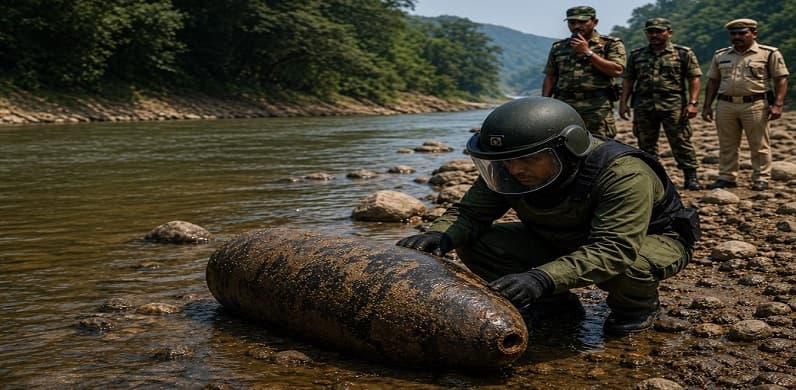
The bomb was discovered in the Subarnarekha River, which flows through the Jharkhand region of eastern India, a state with deep historical ties to India's wartime industrial and logistical infrastructure. Local residents or labourers working near the riverbank first spotted the partially exposed metallic object, unusual in shape and size, partially buried in silt or sand along the riverbed or its banks.
Upon reporting the find to local authorities, police and district officials immediately cordoned off the area. Preliminary inspection confirmed the object matched the profile of an unexploded ordnance (UXO) from the World War II era: cylindrical, heavily corroded, yet structurally intact enough to pose a genuine detonation risk. Experts from the Bomb Disposal Squad were swiftly called in, and a safety perimeter was established around the discovery site. Residents in the immediate vicinity were asked to evacuate while the team assessed the threat level.
The Jharkhand region, situated in the eastern heartland of India, was strategically significant during the 1940s due to its proximity to British-controlled military supply routes and industrial centres supporting the Allied war effort.
Historical Background: Why WWII Bombs Still Exist in India
India played a crucial, if often overlooked, role in World War II. As a British colonial territory, it served as a massive staging ground for Allied operations across Southeast Asia and the Pacific. Cities such as Kolkata (then Calcutta), along with towns across Bengal, Bihar, and Jharkhand, hosted airbases, ammunition depots, and military logistics hubs.
Between 1942 and 1945, the region faced genuine threat from Japanese aerial bombardment, particularly as Imperial Japanese forces advanced through Burma. Allied air forces flew extensive sorties from bases in eastern India, and wartime records document the movement of large quantities of bombs, munitions, and fuel across the region.
Not all of this ordnance was used or properly disposed of. Bombs were sometimes jettisoned from damaged aircraft over rivers and forests. Others were stockpiled, lost during transport, or hastily buried as the war wound down and troops withdrew. Over decades, flooding, erosion, and shifting riverbeds can expose these hidden relics, which is precisely how the Subarnarekha river bomb discovery likely came to light.
This is not unique to India. Across Europe, Southeast Asia, and the Pacific, unexploded WWII ordnance continues to surface regularly, reminding the world that the physical legacy of the war is still very much present.
Why This Discovery Is Important
The significance of this find extends well beyond historical curiosity:
- Public safety risk: An intact WWII bomb carries live explosive material that can still detonate under pressure, heat, or disturbance, even after 80 years.
- Environmental danger: Corroded bomb casings can leach heavy metals and toxic chemicals into the river, threatening water quality and aquatic ecosystems that local communities depend on.
- Civilian awareness: Many people living near old military routes or riverbeds are unaware of the potential dangers beneath the surface. This discovery is a critical reminder.
- Historical significance: Every recovered piece of WWII ordnance adds to our understanding of wartime logistics in India, a chapter of history that remains underrepresented in mainstream accounts.
- Precedent for monitoring: The find demonstrates the need for systematic surveys of rivers, forests, and former military zones across eastern India.
Risks of Unexploded WWII Bombs
The danger posed by WWII unexploded bombs in India, and anywhere in the world, is not theoretical. These devices were designed to detonate reliably, and many of their internal mechanisms remain functional even after decades of corrosion.
An 80-year-old bomb can still contain hundreds of kilograms of TNT or similar high explosives. Triggering mechanisms, though degraded, can become hypersensitive over time, meaning that even minor vibration, drilling, or accidental impact can set them off. The blast radius of a WWII-era bomb can extend several hundred metres, causing fatal injuries, structural damage, and shockwave injuries far beyond the immediate epicentre.
The risk is compounded near water sources. Pressure changes caused by flooding, heavy machinery, or nearby construction can destabilise an ordnance casing without warning. This is why evacuation and a strict exclusion zone are always the first priorities when such devices are found.
How Authorities Handled the Situation
The response to the Subarnarekha River WWII bomb followed established bomb disposal protocols:
- Initial report and verification: Local police received the alert and dispatched officers to confirm the discovery and prevent civilians from approaching.
- Exclusion zone established: A safety cordon, typically several hundred metres in radius, was set up around the object.
- Evacuation of residents: Households within the risk radius were asked to vacate the area until the operation was complete.
- Bomb Disposal Squad deployment: Specialist EOD (Explosive Ordnance Disposal) personnel assessed the bomb's condition, type, and detonation risk.
- Controlled detonation or safe removal: Depending on the condition of the device, the squad either performed a controlled detonation in a safe configuration or carefully transported the bomb to a designated disposal site.
- All-clear issued: Once the ordnance was neutralised, the exclusion zone was lifted and residents were permitted to return.
Throughout the operation, authorities maintained communication with district administration, ensuring that public anxiety was managed with accurate and timely information.
Could More WWII Bombs Still Be Hidden?
The short answer is yes, and the probability is higher than most people realise. Eastern India was densely active with Allied military operations during the early 1940s. Riverbeds across Jharkhand, West Bengal, Odisha, and Assam represent plausible locations for buried or submerged ordnance.
Geographical risk zones include:
- Rivers and floodplains near former Allied airbases and railway lines
- Forests and hillsides that served as wartime storage or crash sites
- Former industrial zones that supported wartime munitions production
Riverbeds are particularly unpredictable because seasonal flooding continually shifts sediment, potentially exposing objects that were deeply buried for decades. Archaeological and geological surveys of high-risk areas, combined with historical military records, could help authorities proactively map potential ordnance sites before accidental discovery puts lives at risk.
Lessons for Public Safety and Awareness
The historical wartime explosives India challenge demands a proactive, community-based approach to safety. Here is what every civilian should know:
- Do not touch or move any suspicious metal object found near riverbeds, old railways, or forested areas, especially if it is cylindrical, heavily corroded, or unusual in shape.
- Clear the area immediately. Move yourself and others at least 300-500 metres away without running or creating vibration.
- Call the police or district emergency services straight away. Provide the exact location, a description of the object, and the names of anyone who may have touched it.
- Do not photograph using flash near the object, and discourage others from approaching out of curiosity.
- Trust professionals. Only trained EOD personnel have the tools and expertise to assess and safely neutralise unexploded ordnance.
Local schools, panchayats, and district authorities in high-risk zones should consider running periodic awareness sessions on ordnance safety as part of disaster preparedness programmes.
Benefits of Early Detection and Professional Handling
When unexploded ordnance is discovered and managed correctly, the outcomes are overwhelmingly positive:
- Reduced casualties: Proper evacuation and controlled detonation prevent accidental deaths and serious injuries.
- Safer communities: Removing latent hazards from residential and agricultural areas restores long-term safety to affected regions.
- Environmental protection: Prompt removal prevents further leaching of toxic materials into river systems and soil.
- Historical documentation: Recovered ordnance can be catalogued, studied, and used to build a more complete picture of India's wartime history.
- Better disaster preparedness: Each successful disposal operation strengthens institutional knowledge and community readiness for future discoveries.
Conclusion
The Subarnarekha River WWII bomb discovery is more than an extraordinary news story; it is a call to awareness. It reminds us that history does not always stay buried, and that the physical remnants of a war fought eighty years ago can still pose real and immediate danger to communities today.
For authorities, it underscores the importance of maintaining trained EOD capabilities and conducting proactive surveys of historically active military zones. For civilians, it is a clear reminder to treat any suspicious object as a potential hazard and report it without delay.
India's wartime history in the east is rich, complex, and still being uncovered, sometimes literally. Vigilance, public education, and professional expertise are the best tools we have to ensure that these relics of the past do not claim victims in the present.
If you or anyone in your community discovers a suspicious object near a riverbank, field, or old railway line, do not approach it. Contact local police immediately. Your report could save lives.