

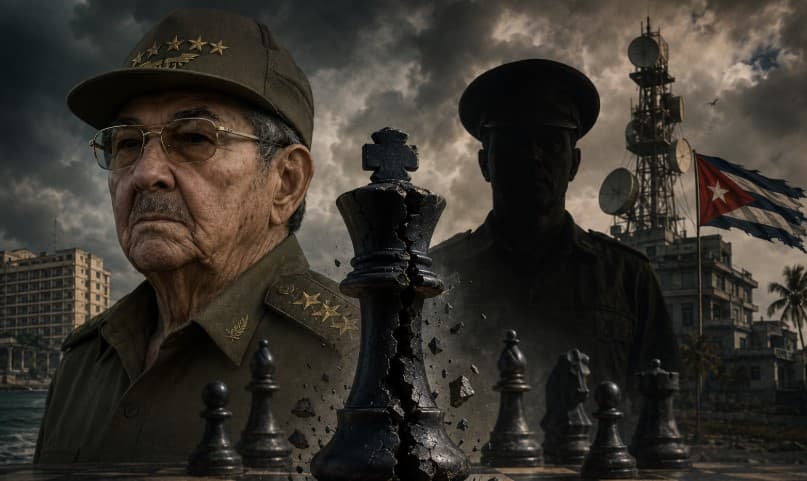
Washington Is Not Pressuring Cuba. It Is Targeting Its Spine.
The Trump administration's Cuba policy is no longer about squeezing an economy. The indictment of Raúl Castro on drug trafficking charges and the systematic dismantling of GAESA, the Cuban military's commercial empire, reveal a sharper and more surgical objective: break the power coalition that has kept the Castro system functional for over six decades. This is not sanctions diplomacy. This is structural decapitation.
What Happened
The US Department of Justice unsealed an indictment against Raúl Castro, Cuba's former president and longtime head of its armed forces, on narcotics-related charges. Simultaneously, the Treasury Department expanded sanctions targeting GAESA, the military conglomerate that controls an estimated 60 to 80 percent of Cuba's hard-currency economy, including hotels, remittance channels, and telecommunications infrastructure. The Biden-era pause on confrontational Cuba policy has ended. The Trump administration has returned with a doctrine that is explicitly elite-targeted.
Why This Matters Beyond Headlines
GAESA is not simply a state enterprise. It is the economic oxygen supply for Cuba's ruling military class. When Washington hits GAESA, it is not hurting ordinary Cubans in the abstract. It is directly threatening the personal financial interests of generals, party officials, and regime insiders who depend on GAESA's revenues for access to resources, luxury goods, and political loyalty networks. The indictment of Raúl Castro serves a complementary purpose: it criminalizes the symbolic head of the system in international legal terms, isolating Cuba further from legitimate financial corridors.
This strategy borrows from the Venezuela playbook. Targeting Maduro's inner circle through sanctions and legal exposure did not collapse Caracas, but it created internal friction and accelerated elite defections. Washington appears to be betting on a similar dynamic in Havana.
Political and Strategic Calculations
For the Trump administration, Cuba remains both a domestic political instrument and a regional strategic concern. Florida's Cuban-American voter base rewards hardline Cuba policy. But there is a deeper calculation at work. Cuba's military elite represents the last organic successor structure to the Castro era. Neither Miguel Díaz-Canel nor any civilian technocrat commands real loyalty. The armed forces do. By legally exposing and economically strangling that group, Washington is removing the institutional safety net that makes orderly regime continuity possible.
The indictment also serves as a deterrent signal to other regional actors, particularly Venezuela and Nicaragua, about Washington's willingness to pursue criminal accountability against heads of state and former heads of state in the Western Hemisphere.
Economic and Security Impact
GAESA's effective exclusion from the US financial system creates cascading pressure. Foreign investors, particularly in tourism and energy, face secondary sanction risks for partnerships with GAESA-linked entities. European hotel chains already operating in Cuba are recalculating exposure. Cuba's access to foreign exchange, already critically strained, narrows further. The immediate humanitarian consequence is real: fuel shortages, food import constraints, and rolling blackouts that have already triggered mass emigration will intensify.
The security dimension involves migration. Economic collapse in Cuba historically generates large-scale movement toward Florida. Washington is aware this pressure point cuts both ways domestically.
Global Reactions and Diplomatic Signals
The European Union has reiterated its opposition to extraterritorial US sanctions. Mexico and Colombia have criticized the indictment as politically motivated legal weaponization. Russia and China, which both hold economic stakes in Cuba, have condemned the measures without proposing concrete countermeasures. The international response reflects a familiar pattern: symbolic opposition without material consequences for Washington's posture.
Cuba's government has dismissed the indictment as a "criminal fabrication," but the legal document itself creates lasting reputational and financial pressure regardless of enforcement.
What Happens Next
Three scenarios are credible. First, incremental elite fracture: financial pressure on GAESA accelerates quiet deal-making between regime insiders and US intermediaries, creating cracks in internal loyalty. Second, regime hardening: the military closes ranks, accelerates repression, and deepens dependence on Russian and Chinese economic lifelines. Third, humanitarian escalation: continued economic deterioration drives record emigration, forcing a US policy recalibration before any political transition occurs.
The most likely near-term outcome is a combination of accelerated defection pressure on mid-level officials and increased Chinese economic engagement as a counterweight.
The Bigger Picture
Washington has concluded that incremental economic pressure on Cuba produces suffering without strategic outcomes. The shift toward directly targeting the ruling military elite reflects a colder, more precise doctrine. Whether it fractures the system or hardens it depends entirely on whether Cuba's generals decide that protecting the regime is still worth the personal cost. That calculation is now actively in motion.