

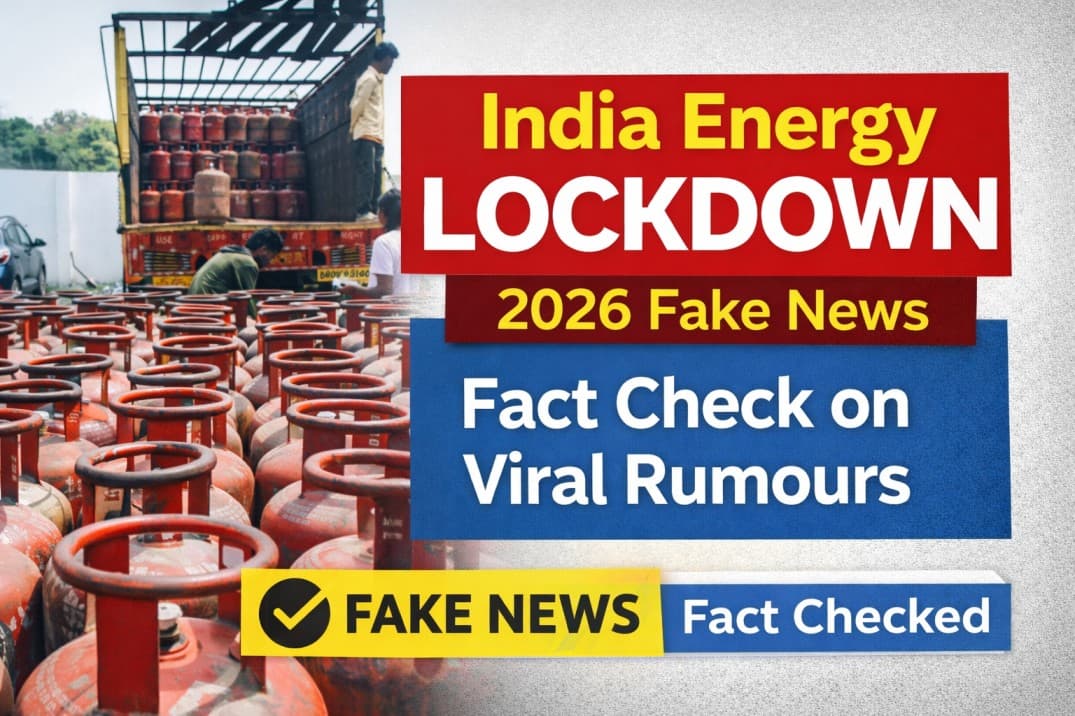
The Claims Under Review
Starting March 25, 2026, a wave of viral messages, videos, and PDF documents spread across WhatsApp groups and social media platforms in India, making several alarming claims:
Claim 1: India is about to go into a nationwide lockdown linked to the West Asia war.
Claim 2: India has only 5 to 10 days of oil reserves left.
Claim 3: The government has quietly changed LPG refill booking timelines to 45 days.
Claim 4: A "partial lockdown effective from April 15, 2026" was announced by the Delhi government.
Claim 5: Petrol pumps are running dry because of a genuine supply shortage caused by the Strait of Hormuz closure.
This fact-check reviews each claim against official government statements, ministry data, and verified news reporting.
Claim 1: India Is About to Enter a Lockdown
Verdict: FALSE
This claim began circulating after social media users misrepresented Prime Minister Modi's parliamentary statements about "preparedness" as a hint of impending COVID-style restrictions.
Union Petroleum Minister Hardeep Singh Puri directly addressed this claim. "Rumours of a lockdown in India are completely false. Let me state this clearly, there is no such proposal under consideration by the Government of India. In such times, it is important that we remain calm, responsible, and united," he stated in an official post.
The government confirmed that PM Modi had used the phrase "COVID-like preparedness" in a parliamentary address, but strictly in the context of energy supply chain management during the West Asia conflict, not in any public health context. The word "lockdown" was never used in any official 2026 government address.
Separately, a PDF document titled "Delhi Govt. Press Release on Partial Lockdown Effective from 15th April 26" circulated on WhatsApp. No such announcement was made by the Delhi government or any central authority. The document was a fabrication. No official press release with that content exists.
Claim 2: India Has Only 5 to 10 Days of Oil Reserves
Verdict: FALSE
This claim, which spread widely through viral videos, is directly contradicted by official government data.
The Ministry of Petroleum and Natural Gas issued a formal statement confirming that India currently has around 60 days of petroleum stock cover, with total reserve capacity extending up to 74 days, including both commercial and strategic reserves. This was also confirmed through a PIB press release on March 26, 2026.
The real context is this: India imports approximately 40% of its crude oil through routes that pass through the Strait of Hormuz. The Iran-US-Israel conflict and Iran's restrictions on commercial shipping through the Strait created genuine concern about future supply. However, Indian oil companies had already secured crude supplies for the next 60 days, multiple LPG cargo ships were already en route from the US, Russia, Australia, and other countries, and India's refineries were operating at over 100% capacity.
India is the world's fourth-largest oil refiner and fifth-largest exporter of petroleum products. The claim of a 5 to 10 day reserve is off by an order of magnitude compared to official government inventory data. India imports oil from over 41 countries, making single-corridor dependency significantly lower than many viral posts implied.
Claim 3: LPG Refill Booking Timelines Were Secretly Changed to 45 Days
Verdict: FALSE
The Ministry of Petroleum and Natural Gas officially addressed this claim through a public clarification issued in late March 2026.
"No such changes have been made," the ministry stated. "Some media reports and social media posts had claimed that refill booking timelines had been altered to 45 days for PMUY beneficiaries, 25 days for non-PMUY single-cylinder users, and 35 days for non-PMUY double-cylinder consumers. As per the existing norms, LPG refills can be booked after 25 days in urban areas and 45 days in rural areas, irrespective of the type of connection."
The government urged citizens not to believe or circulate this misinformation and to avoid unnecessary or panic booking of LPG refills, confirming that the current timelines remain unchanged.
Claim 4: Partial Lockdown Notice Was Issued from April 15, 2026
Verdict: FALSE
A formally formatted PDF titled "Delhi Govt. Press Release on Partial Lockdown Effective from 15th April 26" used official-style language, government-style symbols including the Ashok Chakra, and authoritative formatting to appear authentic.
No ministry, department, or government agency issued such an advisory. GoodReturns confirmed that there has been no official confirmation or announcement from any government authority regarding a partial lockdown from April 15. The document was a hoax designed to simulate an official communication.
A similar message circulated under the heading "Iran war lockdown notice," also using official-looking symbols to create panic. Both were fabrications.
The Ministry of Petroleum issued a direct warning: "The Ministry has noted with serious concern the circulation of misleading videos and posts on social media platforms that selectively use images of queues, global news footage of rationing in other countries, and completely bogus and fabricated claims of impending lockdowns."
Claim 5: Petrol Pumps Are Running Dry Due to a Real Fuel Shortage
Verdict: MISLEADING — Queues Were Real, Shortage Was Not
This is the most nuanced claim and the one that carries the most factual complexity. Queues at petrol pumps were real. The shortage that caused them was not.
In Hyderabad, long queues were reported at pumps in Secunderabad, Jubilee Hills, Banjara Hills, and other areas. In Gujarat, petrol pumps witnessed 8 to 10 times the usual footfall. Fuel meant to last two days was sold out within hours. Some pumps displayed "No Stock" signs.
However, the government and independent analysts confirmed that the cause of these visible shortages was panic buying, not supply failure.
The Telangana Petroleum Dealers Association confirmed that panic buying had pushed fuel sales to nearly 2.5 to 3 times normal levels, leading to temporary stock exhaustion at specific pumps, not across the supply chain. BPCL issued a statement confirming that rumours about petrol and diesel shortages are completely unfounded.
The government confirmed that oil company depots had been operational through the night to ramp up supplies. Oil companies had extended credit to petrol pumps to over 3 days from the earlier 1 day limit to prevent working capital shortfalls from creating artificial gaps. The Ministry confirmed: "Not a single outlet has been asked to ration supply."
The queues were real. The supply crisis that people believed was causing those queues was a misinformation-driven self-fulfilling event.
What Was Actually True About India's Energy Situation
The panic was built on misinformation, but the underlying context was real and significant. India's energy situation in March 2026 was genuinely affected by the Strait of Hormuz conflict.
India lowered fuel taxes in response to rising global energy prices. Petrol duties were slashed from Rs 13 per litre to Rs 3 per litre to protect consumers, according to Al Jazeera's reporting on March 27. Export taxes on diesel and aviation fuel were reimposed.
LPG domestic production was ramped up by 40% following the LPG Control Order, bringing daily output to 50,000 metric tonnes against total daily requirement of approximately 80,000 metric tonnes. Over 800,000 metric tonnes of LPG cargo was already secured from the US, Russia, Australia, and others.
India's Indian Navy also launched Operation Urja Suraksha specifically to escort LPG and crude oil tankers through the Strait of Hormuz with naval warship protection. The government was taking the energy security situation seriously, precisely through the kind of proactive action that the viral claims falsely implied was absent.
The Misinformation Pattern: How It Spread
The Ministry of Petroleum described a "deliberately mischievous, coordinated campaign of misinformation" involving several documented tactics.
Viral posts used images of fuel queues from other countries where rationing genuinely occurred. Some posts misrepresented the Natural Gas Control Order and the LPG Control Order, which are standard administrative supply prioritisation instruments, as emergency declarations signalling crisis. Fake PDFs mimicked official government formatting to claim authority they did not have. Social media accounts amplified these posts during the emotionally resonant period around the sixth anniversary of India's March 24, 2020, COVID lockdown announcement.
Officials warned that spreading false information about essential commodities can attract legal consequences.
Quick Reference: Claim-by-Claim Verdict
Viral Claim | Verdict |
|---|---|
India going into nationwide lockdown | FALSE |
India has only 5 to 10 days of oil reserves | FALSE |
LPG booking changed to 45 days | FALSE |
Delhi partial lockdown from April 15 PDF | FALSE (fabricated document) |
PM Modi hinted at lockdown in Parliament | MISLEADING (misquoted out of context) |
Petrol pumps had no stock due to real shortage | MISLEADING (panic buying, not supply failure) |
India's energy situation is under pressure | PARTLY TRUE (global context, not domestic shortage) |
Conclusion
Every specific lockdown and fuel shortage claim that circulated virally in India during March and April 2026 is either false or misleading.
India has approximately 60 days of petroleum stock. LPG booking rules have not changed. No lockdown was announced or planned. The Delhi government did not issue a partial lockdown notice for April 15. PM Modi did not hint at restrictions.
The queues at petrol pumps were real. The supply crisis that people believed was causing them was not. Panic buying produced visible signs of shortage at individual pumps, which were then photographed and shared as evidence of the shortage that the panic itself was creating.
The government, petroleum companies, the Petroleum Ministry through PIB, and the Union Petroleum Minister all issued categorical denials through official channels. Citizens are advised to verify all fuel, energy, and emergency-related claims through the Ministry of Petroleum's official website, PIB, and government-verified social media handles before sharing.
Fact-Check Rating Scale:
- TRUE: Verified and accurate
- MISLEADING: Contains accurate elements but creates a false overall impression
- FALSE: Directly contradicted by official data and verified sources
Overall viral claim cluster verdict: FALSE to MISLEADING