


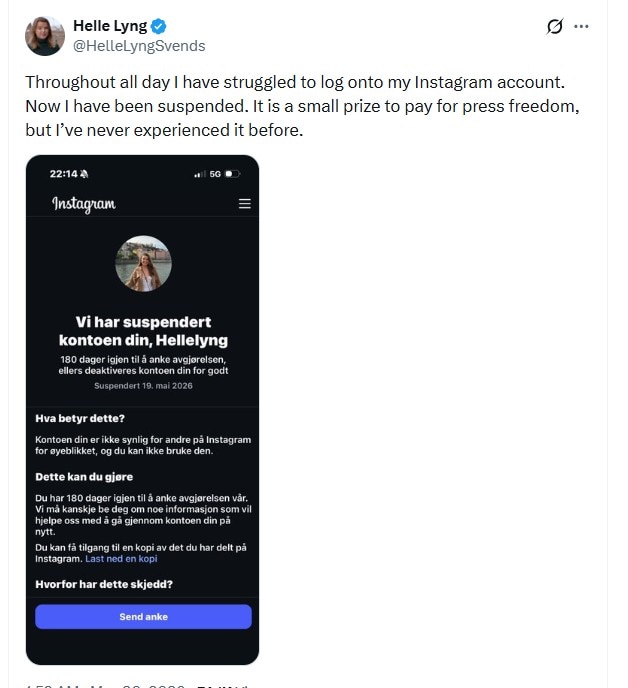
A Norwegian journalist's suspension by Meta has reignited the most consequential debate of the digital era: whether press freedom can survive inside platforms built for profit, not public discourse. The reporter's response, calling it "a small price to pay for press freedom," is both a brave statement and an uncomfortable signal. That someone must frame censorship as an acceptable cost reveals how normalized platform control over journalism has become.
What Happened
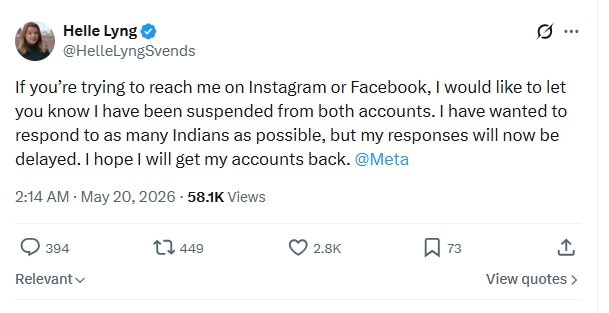
A Norwegian journalist was suspended from Meta's platforms after publishing or sharing content that triggered automated or policy-based enforcement. The reporter publicly accepted the suspension, framing it as collateral damage in the broader fight for editorial independence. The phrase "small price to pay" quickly circulated as a rallying point among press freedom advocates across Europe.
Why This Matters Beyond Headlines
The incident is not about one account. It represents a structural failure in how digital infrastructure intersects with the press. Meta's content moderation systems were built to manage viral misinformation and advertiser sensitivities, not to protect investigative journalism. When those systems encounter hard-edged reporting on sensitive political or corporate subjects, they frequently misfire.
The deeper problem is architecture. Journalists now depend on platforms they do not own, cannot appeal to efficiently, and are subject to terms of service written by corporate lawyers rather than press freedom lawyers. This is not a moderation glitch. It is a governance gap with real consequences for the public's right to be informed.
Political and Strategic Calculations
Meta's suspension decisions rarely happen in a political vacuum. European regulators have been tightening scrutiny of platforms under the Digital Services Act, and platforms have responded by over-moderating in some areas to demonstrate compliance, which can inadvertently suppress legitimate reporting. Meanwhile, governments with interest in suppressing certain narratives benefit indirectly when platforms do the work for them.
Norway, as a country consistently ranking at the top of global press freedom indices, becomes a pointed example when one of its journalists faces platform suspension. It signals that even in liberal democracies with strong legal protections for the press, the actual distribution of journalism is hostage to private platform decisions made in California.
Economic and Security Impact
Journalism's economic model is now deeply entangled with platform reach. A suspended account means lost audience, reduced traffic, diminished advertising revenue, and weakened institutional voice. For independent journalists or smaller outlets, a Meta suspension can be economically devastating, far beyond the "small price" framing.
The security dimension is subtler but serious. When investigative reporters covering corruption, military affairs, or corporate wrongdoing face platform suspensions, sources dry up and information ecosystems narrow. This creates conditions where power operates with less public scrutiny, which is a security risk for democratic governance itself.
Global Reactions and Diplomatic Signals
Across Europe, the reaction has been pointed. Press freedom organizations including Reporters Without Borders have consistently flagged platform dependency as an emerging threat to media independence. The European Federation of Journalists has called for structural remedies, including mandatory fast-track appeals for credentialed journalists facing suspension.
In the United States, the response has been more muted, largely because the political debate around platform power has fractured along partisan lines, making coherent press freedom advocacy harder to sustain.
What Happens Next
The Digital Services Act creates real leverage. If European regulators treat unjustified journalist suspensions as violations of media freedom provisions, Meta faces the prospect of significant fines and mandatory process reforms. That regulatory threat is the most credible near-term check on platform behavior.
Longer term, the push for journalist-specific protections within platform governance frameworks will intensify. Proposals for independent oversight boards with genuine authority over press-related suspensions, rather than Meta's current internal review structures, are likely to gain traction in Brussels.
The Norwegian reporter's composure under suspension is admirable. But composure should not be required. A press freedom architecture that demands journalists absorb censorship stoically rather than preventing it institutionally is one that has already conceded too much ground to platform power.
Conclusion
What makes this moment significant is not the suspension itself but what accepting it reveals. When journalists call platform censorship a tolerable cost, the conversation has already shifted from whether this is acceptable to how much of it is survivable. That is the question regulators, newsrooms, and democratic governments must answer before the price becomes too high to pay.