

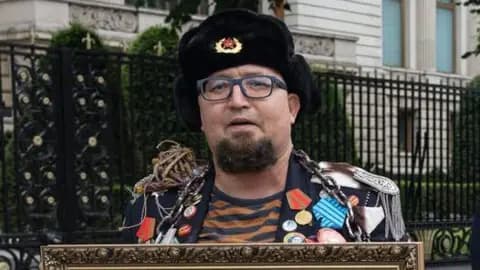
Police in Poland are investigating the execution-style murder of a Russian artist shot and vocal critic of President Vladimir Putin, in a killing that has raised immediate questions about the involvement of foreign actors so close to the country's eastern border.
Polish prosecutors said Robert K, known publicly as the artist Semyon Skrepetsky, was shot dead on Monday morning in the Polish city of Biała Podlaska, located approximately 40km (25 miles) from the Belarusian border.
A Brutal and Deliberate Attack
The 44-year-old was shot five times in the head, chest and back in a car park in the city, in an attack that took place roughly 600m from the Belarusian consulate. The proximity of the killing to the consulate has not gone unnoticed by investigators examining the circumstances surrounding his death.
Marcin Kozak, spokesman for the District Prosecutor's Office in Lublin, said the artist was approached by an unidentified gunman who fired two shots at him.
"When the victim fell to the ground, the perpetrator approached, fired three more shots and then quickly fled the scene. Robert K died at the scene."
Investigators recovered five shell casings and one Geco 9mm Luger bullet from the crime scene, according to Kozak. An autopsy has been scheduled for Wednesday, which is expected to provide further detail on the precise sequence of the attack.
Who Was Semyon Skrepetsky?
Semyon Skrepetsky was the pseudonym used by Robert Kuzovkov, an artist known for his pointed political caricatures. His work targeted some of the most powerful and controversial figures in the region, including Vladimir Putin, Belarusian leader Alexander Lukashenko and Chechen leader Ramzan Kadyrov.
Kozak described the nature of the artist's public work in detail, noting his consistent and open criticism of the Kremlin.
"The victim engaged in public artistic activities and used, among other things, the pseudonym Semyon Skrepetsky, under which he expressed criticism of the current policies of the Russian Federation authorities."
Media reports indicate that Skrepetsky relocated to Biała Podlaska in 2021, settling in the Polish city not far from the border he would later be killed near.
Two Belarusian Citizens Detained
Police detained two Belarusian citizens, aged 33 and 37, near the Belarusian consulate in the city shortly after the attack. Their precise role in the incident was still being determined, Kozak said, leaving open the question of whether the detentions are directly connected to the killing or part of a broader line of inquiry.
The location of their detention, so close to both the consulate and the scene of the murder, is likely to remain a significant focus for investigators as the case develops.
A History of Public Defiance
Skrepetsky's activism extended well beyond his artwork. Video posted recently on social media showed him taking part in a Russia Day protest outside the Russian embassy in Berlin on 12 June, just days before his death.
During the demonstration, he carried a painting caricaturing both Putin and Soviet leader Joseph Stalin, while a Russian flag, tied to his trousers, dragged along the road behind him; a visibly provocative act of protest that underscored the open and public nature of his opposition to the Kremlin.
His willingness to appear publicly at such demonstrations, despite the risks associated with criticising Putin and other authoritarian leaders in the region, has drawn attention to the broader pattern of violence and intimidation faced by Russian dissidents living in exile.
Investigation Continues
Polish authorities have not yet confirmed a motive for the killing, nor have they established a definitive link between the detained Belarusian citizens and the gunman responsible for the attack. The case remains under active investigation, with Wednesday's scheduled autopsy expected to offer further forensic clarity.
The killing adds to a growing list of incidents involving threats and violence against Kremlin critics living abroad, and is likely to intensify scrutiny of security arrangements for Russian and Belarusian dissidents operating near Eastern Europe's borders.