


A Seismic Shift in the Upper House
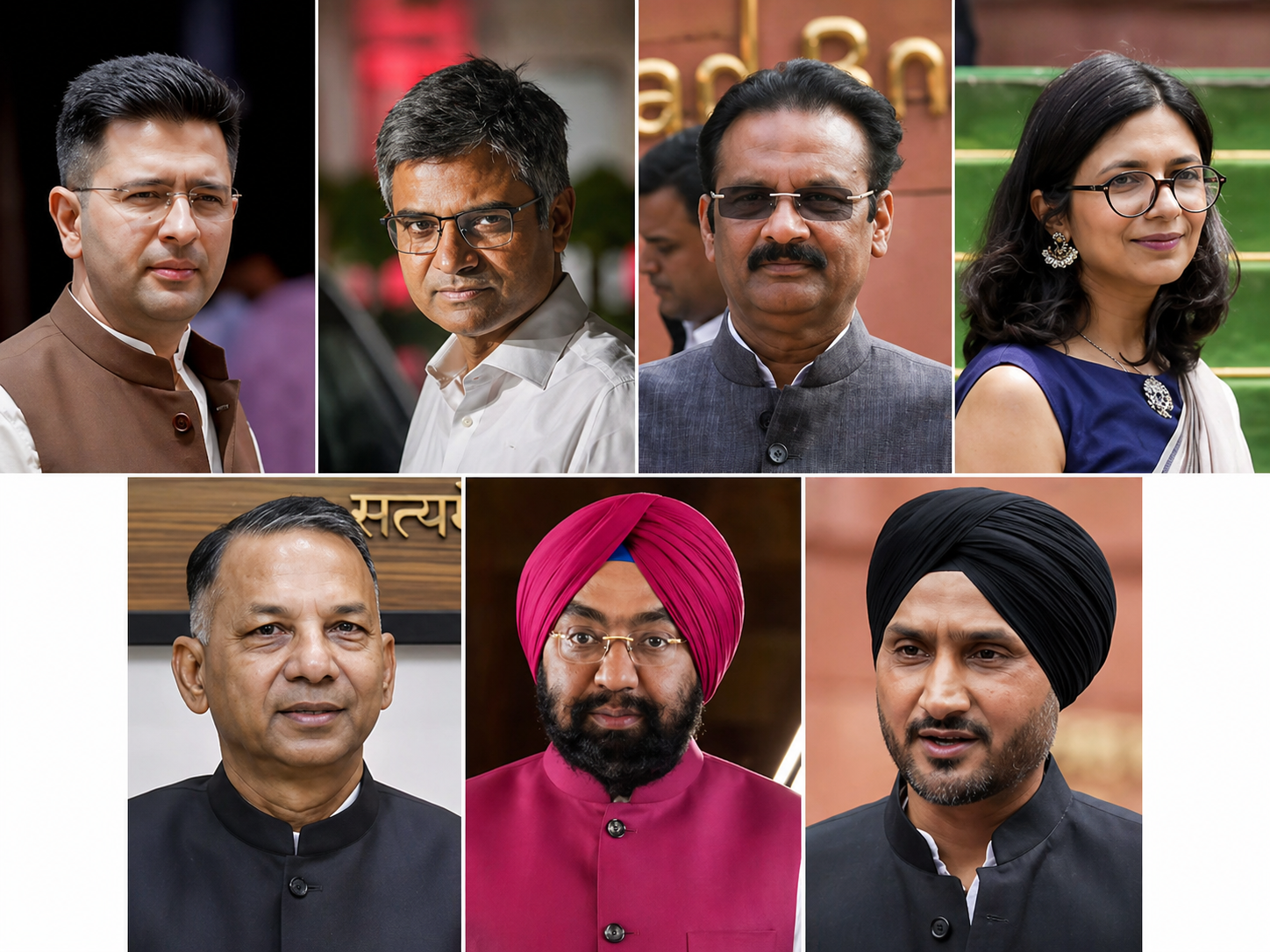
In a development that has sent ripples through New Delhi's political corridors, seven former Members of Parliament affiliated with the Aam Aadmi Party (AAP) have formally joined the Bharatiya Janata Party (BJP). The move, confirmed by party officials on both sides, immediately reconfigures the arithmetic of the Rajya Sabha, India's Council of States, pushing the National Democratic Alliance's (NDA) combined strength to a formidable 148 seats in the upper house.
This is not merely a numerical adjustment. In the Indian parliamentary system, the Rajya Sabha is not a rubber-stamp chamber. It is a deliberative body with the power to delay, amend, or in many cases, block legislation. Several landmark bills in India's recent history have stalled or been significantly renegotiated precisely because ruling coalitions lacked the numbers to carry them through the upper house. Against that backdrop, the addition of seven members, however they arrive, carries consequences that extend well beyond headline politics.
The development also raises immediate questions of constitutional validity, political ethics, and the structural robustness of India's anti-defection framework. Is this a case of political defection as defined under the Tenth Schedule of the Constitution? Or does it represent a legally permissible exercise of political freedom by individuals who chose to resign from one party and join another? The answers, as always in Indian constitutional jurisprudence, are layered with nuance.
This analysis examines the event from every dimension: legal, political, strategic, ethical, and electoral, to offer a comprehensive account of what this development means for Indian democracy.
Rajya Sabha Arithmetic: The New Power Balance
The Rajya Sabha currently has a sanctioned strength of 245 members, of which 233 are elected by state legislatures and 12 are nominated by the President. For most legislation, a simple majority of members present and voting is sufficient for passage. However, for constitutional amendments under Article 368, a special majority is required, defined as a two-thirds majority of members present and voting, provided that majority also constitutes more than half the total membership of the House.
Prior to this development, the NDA had been operating in the Rajya Sabha at a strength that allowed it to pass ordinary legislation with manageable coalition support, but constitutional amendments and contentious bills often required careful negotiation with smaller regional parties or independents. The addition of seven seats, pushing NDA's combined count to 148, changes that calculus in meaningful ways.
A simple majority in the Rajya Sabha requires 123 votes when all members are present. At 148, the NDA now commands a comfortable cushion above that threshold, even accounting for routine absenteeism and procedural disruptions. More critically, the bloc is now within a realistic distance of the special majority threshold in contexts where attendance may be lower than full capacity.
The impact on pending legislation is immediate. Several bills related to economic reform, judicial appointments, and federal reorganisation that have been caught between the two houses may now find an easier path in the upper house. Opposition parties, particularly those with regional strongholds, will find their bargaining leverage reduced. Smaller coalition partners within the NDA, who previously held disproportionate influence as swing votes, may see their positional power diminish as the ruling alliance becomes more self-sufficient.
The development also affects the Opposition's ability to use the Rajya Sabha as a counter-majoritarian check, a role the upper house has historically played with considerable effect during periods of single-party dominance in the Lok Sabha.
Anti-Defection Law: Does This Crossing Qualify as Defection?
What the Tenth Schedule Says
The Anti-Defection Law, enshrined in the Tenth Schedule of the Constitution through the 52nd Constitutional Amendment in 1985, was introduced to address the phenomenon of "Aaya Ram Gaya Ram" politics, a reference to the infamous political carousel of the 1960s when legislators switched parties with alarming regularity. The law aimed to provide stability to elected governments and enforce a degree of ideological consistency on legislators.
Under the Tenth Schedule, a member of either House of Parliament is liable for disqualification if they voluntarily give up membership of the political party on whose ticket they were elected, or if they vote or abstain from voting contrary to the direction of their party whip without prior permission.
The law provides for two primary exceptions to disqualification. First, if at least two-thirds of the members of a legislative party merge with another party, the merger is not treated as defection for those members who join the new entity. Second, if a member is elected as Speaker or Deputy Speaker and resigns from their party, they are protected.
The Critical Question: Former MPs
The most significant legal distinction in the present case is the term "former." If these seven individuals were no longer serving MPs at the time of their joining BJP. That is, if their terms had concluded, or if they had resigned from the Rajya Sabha prior to formally enrolling in BJP, then the Tenth Schedule's provisions may not apply to them at all. The anti-defection law governs the conduct of sitting legislators, not private citizens or ex-lawmakers.
The Rajya Sabha has a rotating membership, with one-third of its members retiring every two years. If these seven were among those whose terms had expired, their decision to join BJP would be constitutionally unencumbered and legally unimpeachable.
However, if any of the seven were sitting members who formally resigned their Rajya Sabha seats before crossing over, the legal analysis becomes more complex. Resignation from a legislative seat is generally permissible and the Tenth Schedule does not penalise a member for leaving Parliament entirely. The law targets those who remain legislators while switching parties. Resignation, in effect, may serve as a route around the anti-defection framework.
Merger Provisions and the Numerical Threshold
The merger exception under the Tenth Schedule requires that at least two-thirds of the original legislative party join the new entity. AAP's Rajya Sabha presence, prior to any departures, was a limited group. Whether seven members constituted two-thirds of AAP's Rajya Sabha legislative party at the time of the move would be a determinative factor if disqualification proceedings were initiated.
Role of the Rajya Sabha Chairman
The Chairman of the Rajya Sabha is the constitutional authority empowered to decide disqualification petitions under the Tenth Schedule. Unlike the Speaker of the Lok Sabha, the Chairman is also India's Vice President, an elected constitutional figure with a fixed term. Petitions challenging the validity of political moves such as these would be filed before the Chairman's office, which would then provide the accused members an opportunity to be heard before delivering a decision.
Judicial review of the Chairman's decision is available before the Supreme Court, though courts have historically been reluctant to intervene in anti-defection matters until the constitutional authority has spoken.
Constitutional and Legal Dimensions
Indian jurisprudence on defection has evolved considerably since the Tenth Schedule's enactment. The Supreme Court's landmark decision in Kihoto Hollohan vs. Zachillhu (1992) upheld the constitutional validity of the anti-defection law while establishing that the Speaker or Chairman's decisions are subject to judicial review, though only after the authority has rendered a decision.
Subsequent cases, including Ravi S. Naik vs. Union of India (1994) and Raja Ram Pal vs. Speaker, Lok Sabha (2007), further refined the contours of what constitutes voluntary relinquishment of party membership. The courts have held that conduct inconsistent with membership, such as publicly campaigning against one's party or attending rival party functions, can itself amount to voluntary relinquishment even without a formal resignation letter.
The concept of constitutional morality, increasingly invoked by the Supreme Court in diverse contexts, is relevant here as well. Even where an action may be technically legal, it may conflict with the values and spirit underlying the constitutional provision. The anti-defection law was conceived to prevent legislators from treating their elected positions as personal property transferable to the highest bidder. Whether the present moves honour that spirit, or circumvent it through procedural means, is a question that legal scholars and constitutional commentators will examine with considerable interest.
BJP's Strategic Perspective
From the ruling party's standpoint, this development represents a calculated and successful strengthening of its parliamentary position without contesting a single additional election. BJP has pursued a consistent strategy in recent years of expanding its Rajya Sabha presence through a combination of electoral victories in state legislatures, alliances with regional parties, and the periodic assimilation of legislators from the opposition.
The timing is strategically significant. A stronger Rajya Sabha position enhances BJP's ability to advance its legislative agenda through Parliament without the delays, dilutions, and negotiations that a slimmer upper house margin would necessitate. Reforms in areas ranging from direct taxation to land acquisition, judicial appointments to labour market regulation, have at various points encountered resistance in the Rajya Sabha. With 148 seats, the path for priority legislation becomes considerably smoother.
From an electoral positioning perspective, the absorption of AAP members also sends a signal to voters in states where AAP remains a competitive force, most notably Delhi and Punjab, that the party is experiencing internal stress and a loss of faith among its own elected representatives.
AAP and the Opposition: A Strategic Setback
For AAP, the loss of seven former MPs to the BJP represents a compound blow. Politically, it diminishes the party's claim to being an incorruptible, ideologically distinct alternative to mainstream political parties. The defection narrative, regardless of its precise legal characterisation, will be used by critics to suggest that AAP's representatives are as susceptible to BJP's gravitational pull as those of any other party.
Within the broader INDIA bloc of opposition parties, the development undermines the narrative of a unified front against the BJP. If constituents of the opposition are peeling away, it raises uncomfortable questions about the cohesion and durability of the coalition, particularly as the nation approaches the next electoral cycle.
AAP is likely to respond with a combination of legal challenges, political messaging around ideological betrayal, and internal disciplinary proceedings. The party may also seek to reinforce loyalty among its remaining elected representatives through public commitments and ideological consolidation exercises.
Public Reaction: Voters, Trust, and Democratic Accountability
The public perception of such political crossovers in India is complex and has evolved over time. A significant segment of the electorate, particularly first-time voters and those who supported AAP for its anti-establishment promise, will view this development as a betrayal of the mandate they conferred. The act of voting for a candidate is, for many citizens, also an act of faith in the party platform and the candidate's stated commitment to it.
However, a parallel segment of public opinion tends to adopt a more pragmatic view of political mobility. In this reading, politicians are rational actors responding to changing incentives, and voters should judge their representatives on the totality of their governance record rather than their party affiliation at any given moment.
Neutral observers, including political scientists, civil society analysts, and ordinary citizens disengaged from partisan affiliation, often focus on the systemic dimension: the absence of a sufficiently robust mechanism to deter post-election party switching. They argue that the real failure is not of individual politicians but of an institutional design that makes such transitions possible, and sometimes rewarding.
Media and Social Media: Competing Narratives
Television news coverage is likely to reflect the ideological predispositions of India's highly polarised media landscape. Channels aligned with the ruling establishment will frame the development as a natural affirmation of BJP's growing national appeal and the recognition by former AAP members that governance effectiveness lies with the ruling party. Opposition-aligned media will deploy the defection framing, emphasising alleged coercion, inducements, or institutional pressure as motivating factors.
Social media platforms will amplify both narratives simultaneously, with partisan hashtags trending in both directions. The phenomenon of selective outrage, where the same act is condemned or celebrated depending on which party benefits, is well-documented in Indian digital political discourse. Political analysts tracking social media trends during similar past events have consistently observed that public opinion is less influenced by the specifics of any given defection and more by the audience's pre-existing party loyalties.
Historical Context: Defections and Realignments in Indian Politics
India's parliamentary history is punctuated with episodes of mass defection, tactical party switching, and legislative poaching. The 1960s and early 1970s represent the most turbulent period, before the anti-defection law was introduced. The 1985 legislation substantially curbed the frequency of individual defections but did not eliminate the phenomenon, as subsequent decades demonstrated.
Notable episodes include the collapse of multiple state governments in the 1990s and 2000s, facilitated in part by engineered crossovers. The bifurcation of regional parties, the orchestrated mergers that technically satisfied the two-thirds threshold under the Tenth Schedule, and the strategic use of governor's discretion in hung legislatures have all featured in Indian political history as instruments of majoritarian consolidation.
The present episode fits within a recognisable pattern of ruling parties at the national level using their institutional strength to draw legislators away from opposition formations. Whether this constitutes normal political realignment or a more troubling democratic pattern is a question that political historians will answer with the benefit of fuller context.
Electoral Impact: Long-Term Consequences
For the BJP, a stronger Rajya Sabha position reinforces the narrative of an unassailable national party, an image that has considerable electoral utility, particularly in states where the party is seeking to establish or consolidate its presence. The optics of AAP politicians choosing BJP can be used in campaign narratives during state elections in Delhi, Punjab, and other AAP-contested territories.
For AAP, the immediate electoral challenge is one of narrative management. The party must convincingly argue that the departing members represented a dissident fringe rather than a broader crisis of confidence, and it must demonstrate that its governance record in Punjab remains strong enough to retain voter loyalty.
At the national level, the episode may accelerate the BJP's broader project of transforming India's political landscape from a multi-party competitive system to one in which the ruling party commands not merely a Lok Sabha majority but a cross-institutional dominance that makes meaningful legislative opposition increasingly difficult.
Governance Impact: What Changes on the Policy Front
In practical terms, a stronger Rajya Sabha position for the NDA shortens the time required to pass legislation that the government considers priority. Bills that have languished in inter-house disagreement may be revived. The government may feel emboldened to introduce legislation it had previously deferred due to upper house uncertainty.
Areas of potential policy acceleration include reforms to the land acquisition framework, changes to labour law consolidation already partially implemented, potential amendments to constitutional provisions governing reservations or federal financial arrangements, and legislative action on judicial reform proposals that have previously faced upper house scrutiny.
The acceleration of the government's legislative agenda also changes the dynamics of federal relations. States governed by opposition parties use their representation in the Rajya Sabha as one mechanism to check central legislative overreach. A weakened opposition bloc in the upper house correspondingly reduces the institutional leverage of non-BJP state governments.
The Ethical Debate: Democracy, Freedom, and Opportunism
The philosophical debate surrounding party switching touches upon foundational questions about the nature of political representation. One school of thought holds that elected representatives are primarily agents of the voters who elected them, bound by the mandate conferred under a specific party platform. Under this view, switching parties constitutes a breach of trust that cannot be remedied by legal technicality.
The opposing perspective treats elected legislators as autonomous political actors whose primary obligation is to their conscience and their assessment of what best serves the public interest. Under this formulation, the anti-defection law itself may be seen as an unconstitutional constraint on free political expression, a view that has found some academic support, though not judicial endorsement.
The tension between these positions has never been fully resolved in Indian constitutional law, precisely because both contain genuine democratic values. Trust and accountability pull in one direction; freedom of conscience and evolving political judgment pull in another. The resolution, in practice, tends to be determined by the institutional mechanisms available, and by the willingness of those mechanisms to be applied impartially.
Expert Commentary
Constitutional scholars note that the legality of this move will hinge on the precise sequence of events, specifically whether the individuals ceased to be Rajya Sabha members before joining BJP. If the sequence is resignation followed by enrolment, the Tenth Schedule may simply not apply. The law was designed to curb defection by sitting members, not to bind former legislators for life.
Political analysts observing NDA's parliamentary strategy observe that the ruling alliance has demonstrated consistent sophistication in building upper house strength through mechanisms that individually may be legally defensible but cumulatively represent a deliberate erosion of the opposition's institutional position.
Election observers focused on democratic health raise a different concern. The recurring pattern of post-election political realignments tilting toward the ruling party at the national level, irrespective of which party is in power, reflects structural incentives that weaken electoral accountability. When voters elect a candidate on one platform and that candidate subsequently joins the opposing establishment, the informational value of the original electoral outcome is degraded.
Future Scenarios: What Happens Next
Scenario One: No Legal Action
The most probable outcome, particularly if these seven individuals had formally ceased to be Rajya Sabha members before joining BJP, is that no disqualification proceedings are initiated. The Chairman's office will have no jurisdiction over private citizens, and BJP will consolidate its upper house strength without legal challenge. This scenario reinforces the ruling party's legislative position and sets a precedent for future strategic recruitment of former opposition legislators.
Scenario Two: Disqualification Proceedings
If any of the seven were sitting members at the time of their formal enrolment in BJP, disqualification petitions could be filed before the Rajya Sabha Chairman. Such proceedings would be legally protracted, subject to high court and Supreme Court scrutiny, and their outcome would depend heavily on the factual record of the precise timeline of resignations, party enrolments, and communications. Historical precedent suggests that such proceedings rarely result in swift or definitive outcomes.
Scenario Three: Broader Political Realignment
The more significant long-term possibility is that this episode catalyses further political realignment, with either additional AAP legislators signalling willingness to cross over, or other opposition parties experiencing similar recruitment pressures. If the pattern accelerates, it could prompt the INDIA bloc to undertake a serious structural review of its coalition architecture and anti-poaching measures, potentially including stricter internal mechanisms for testing legislator loyalty.
Conclusion: A National Political Turning Point?
The formal entry of seven former AAP MPs into the BJP is, in isolation, a bounded political event. In context, it is a data point in a larger transformation of India's parliamentary arithmetic and party system.
Legally, the event may be unimpeachable. If the individuals resigned their seats before joining BJP, the anti-defection law does not apply to them. Constitutionally, the transfer of legislative strength to the ruling party through recruitment rather than election raises questions about the health of India's competitive party system that neither law nor courts are fully equipped to answer.
Politically, the development reinforces BJP's dominance of the national institutional landscape and places fresh pressure on AAP at a moment when the party is already navigating governance and legal challenges in its key states. The Rajya Sabha, historically a chamber of deliberation and a check on majoritarian excess, will function differently at 148 NDA seats than it did before this development.
For Indian democracy, the event offers an opportunity for sober reflection on whether existing constitutional mechanisms, including the anti-defection law, the constitutional role of the upper house, and the norms governing political competition, remain adequate to the pressures of the contemporary political environment. That reflection, if it occurs, will be one of the most consequential outcomes of an otherwise transactional political episode.
The true measure of a democracy is not whether such events can legally occur. It is whether the institutions, the political culture, and the public hold those who engage in such events accountable for the quality and consistency of their public conduct over time.