

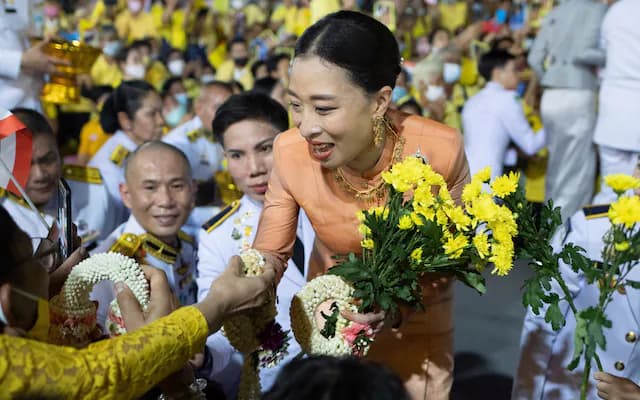
Thailand Princess Bajrakitiyabha has died after spending more than three years in a coma, the royal household announced on Friday. She was 47. Her passing marks a profound loss for the Thai royal family and deepens an already uncertain question of succession that the country's strict laws forbid from being discussed openly.
The princess collapsed in December 2022 while exercising her dogs. Doctors attributed her condition to a severely irregular heartbeat triggered by a mycoplasma infection in her heart. Despite years of intensive medical care, she never regained consciousness.
The palace confirmed she passed away at 19:48 local time on Thursday evening at Chulalongkorn Hospital in Bangkok. In its official statement, the palace said: "The medical team provided the closest and most intensive care possible, but her condition continued to decline progressively."
A Royal of Rare Distinction
Born on 7 December 1978, Princess Bajrakitiyabha was the eldest of King Vajiralongkorn's seven children, born to his first wife and cousin, Princess Soamsawali. From an early age, she distinguished herself through academic excellence, discipline and a genuine commitment to public service that set her apart from the ceremonial expectations of royal life.
She trained as a lawyer, earning two postgraduate degrees from Cornell University in the United States. After a stint at the Thai mission to the United Nations in New York, she returned home to serve in the Attorney General's offices in Bangkok and across the country, building a reputation as a rigorous legal mind with real-world experience.
Diplomat, Advocate and Reformer
From 2012 to 2014, she served as Thailand's ambassador to Austria, where she forged a close working relationship with the UN Office on Drugs and Crime (UNODC). That partnership shaped the cause she would champion for years to come.
She became a passionate and persistent voice for penal reform, focusing in particular on vulnerable women caught up in Thailand's criminal justice system. Thailand has one of the world's highest rates of female incarceration, and the princess spoke openly about the need to address the disproportionate impact of harsh drug sentencing laws on women from disadvantaged backgrounds.
On returning to Thailand, she was appointed the UNODC's Ambassador for the Rule of Law in South East Asia, a role that gave her an international platform to continue pushing for change. Her advocacy was not merely symbolic. She engaged directly with legal institutions, urged policy reform and used her royal status to draw attention to an issue that many in power preferred to ignore.
In 2021, King Vajiralongkorn appointed her chief of staff of his private bodyguard, granting her the rank of general. It was a visible sign of the trust and confidence her father placed in her, and it only added to the sense among royal watchers that she was being groomed for a larger role.
Away from public duties, she was a devoted fitness enthusiast who regularly participated in long-distance runs, embodying the discipline that defined her approach to life.
A Succession Left Unresolved
Her abilities, her international profile and the evident trust her father placed in her made Princess Bajrakitiyabha a constant subject of quiet speculation about the future of the Thai monarchy.
King Vajiralongkorn, now 73, has not named an heir. Thai royal custom holds that succession should pass to a male, but a 1974 constitutional amendment permits a woman to ascend the throne. The king has five sons. Four, born of his second marriage, were disowned in 1996 and have lived in the United States with their mother ever since. His fifth son, Prince Dipangkorn, from his third marriage, is widely considered the presumed heir, though questions persist about his readiness to carry the weight of an institution that commands enormous influence over Thai public and political life.
For many Thai royalists, Princess Bajrakitiyabha represented the most capable and credible figure to lead the monarchy forward, whether as queen in her own right or as regent supporting Prince Dipangkorn.
Her death leaves that future deeply uncertain. And Thailand's severe lese majeste laws ensure that the debate, however urgent, cannot be held in public.