

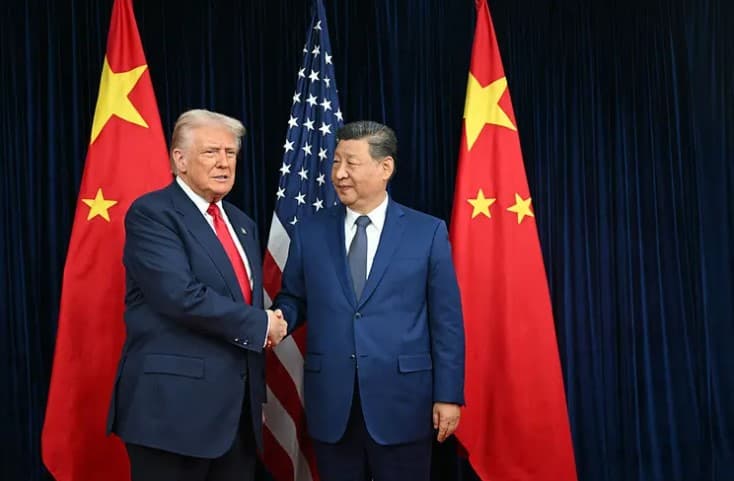
Trump's first Beijing visit since 2017 arrives amid an Iran war, a tech cold war, and a trade ceasefire that remains dangerously fragile. What happens in the Great Hall of the People will echo far beyond its walls.
When Donald Trump lands in Beijing, he carries with him three wars: a shooting war over Iran, a technology war over semiconductors, and an unresolved trade war held together by a ceasefire that both sides know is temporary. His meeting with Xi Jinping on May 14 and 15, 2026, is the first time a US president has visited China in nearly a decade. The timing, the backdrop, and the stakes have no recent precedent.
Trump in China is not simply a diplomatic visit. It is a live negotiation between the two economies that together account for over 40 percent of global output, conducted while a Gulf war disrupts energy markets, while Taiwan watches every syllable spoken, and while the global semiconductor supply chain hangs on decisions made behind closed doors.
Story at a Glance
What
US-China summit in Beijing, May 14-15, 2026. First presidential visit to China since 2017.
Why
Trade truce fragile, Iran war raging, tech cold war escalating, Taiwan tensions rising.
Who
Trump seeks economic wins before midterms. Xi needs stability without appearing to capitulate.
When
Two days of talks. Six months before US midterm elections. Seventy-six days into the Iran conflict.
Where
Great Hall of the People, Beijing. Symbolic venue asserting China's sovereign confidence.
How
Through bilateral deal making, purchase commitments, tariff pauses, and mutual face-saving language.
Data at a Glance | 80% Iran's crude exports purchased by China | 50% China's crude imports from Middle East |
$11bn US military sales package approved for Taiwan | 9 yrs Since a US president last visited Beijing | 90% Global rare earth refining controlled by China |
What Happened
A Visit Delayed by War, Defined by Mutual Dependency
The Trump-Xi summit was originally scheduled for earlier in 2026, but the outbreak of the Iran war pushed the meeting back by months. When Trump finally arrived in Beijing, his administration had already signaled that trade, not Iran, would headline the agenda. Yet the Iran conflict shadows every conversation, because China remains Tehran's dominant oil customer and Washington needs Beijing's leverage to bring Iran back to any negotiation table.
The two sides enter the summit carrying separate lists of demands. Washington wants China to buy more American agricultural goods, resume rare earth exports disrupted by Beijing's own counter-sanctions, and cooperate on Middle East energy stability. Beijing wants the US to ease technology restrictions that are choking its access to advanced semiconductors and chip-manufacturing equipment.
"Each side wants greater autonomy, yet both remain tied to a structure of mutual dependence that neither can easily dismantle without hurting itself." - Salvador Santino Regilme, Leiden University, International Relations
Why It Matters Beyond Headlines
Rivalry Runs Deeper Than Tariffs. This is About Who Writes the Rules.
The surface narrative of Trump in China is about tariffs and trade deficits. The structural narrative is about something larger: which power sets the terms of the global technological and economic order for the next generation. Every chip restriction, every rare earth export control, every arms sale to Taiwan is a move in that longer game.
The US semiconductor restrictions were not simply protectionist policy. They were a deliberate attempt to slow China's military AI capacity, its indigenous chip production, and its ability to develop next-generation weapons systems independently. China's rare earth controls were a matching counter-move, targeting American automotive, aerospace and defence sectors precisely where supply chains are most brittle.
Strategic Depth Analysis
Why the paradox of rivalry and dependence makes this summit both essential and unstable
- The US still relies on China's manufacturing scale for consumer goods, pharmaceuticals and electronics that no near-term reshoring can fully replace.
- China's export machine depends on access to US consumers and the stability of a dollar-anchored global trading system it officially criticises.
- Both governments now frame economic interdependence as a strategic vulnerability, yet severing it completely would cause domestic economic damage neither can absorb.
- The summit, therefore, is not a resolution meeting. It is a managed friction exercise, slowing the decoupling while preserving the appearance of competition for domestic audiences.
Who Benefits — Who Loses
Political Calculations on Both Sides of the Pacific
Trump benefits if he returns from Beijing carrying visible deals: soya bean purchase agreements, a rare earth resumption, perhaps a symbolic step on Iran. With US midterm elections six months away, every economic headline matters. His foreign policy brand is built on the performance of dealmaking, not its architecture.
American farmers, automakers and aerospace companies gain if Beijing resumes critical mineral exports. US consumers benefit if a tariff de-escalation lowers prices on electronics and consumer goods.
Xi benefits if he secures any rollback of semiconductor export controls without appearing to have conceded on Taiwan or sovereignty. Domestic audiences in China need to see their president negotiating from strength, not from accommodation.
Taiwan loses if the optics of a warm Trump-Xi relationship create ambiguity about US defence commitments. The precise language used after the summit on arms sales and Taiwanese sovereignty will be parsed in Taipei with existential attention.
Economic & Security Impact
From the Strait of Hormuz to Silicon Valley: Everything Is Connected
The Iran war has transformed what might have been a purely bilateral trade summit into a global energy security conference. About half of China's crude oil arrives from the Middle East, and disruptions in the Strait of Hormuz carry direct economic consequences for Beijing. Both Washington and Beijing want the strait open, but they disagree entirely on how to get there and who bears responsibility for getting it done.
The technology dimension is equally consequential. Advanced chip restrictions have slowed but not stopped China's AI development. They have, however, accelerated Beijing's investment in domestic semiconductor capacity at a scale that Western analysts acknowledge will eventually reduce the effectiveness of export controls. Washington is racing against a timeline of its own making.
For global markets, the summit offers either reassurance or alarm. A visible handshake and modest deals tend to reduce volatility in Asian equity markets and stabilize commodity prices disrupted by the Gulf conflict. A breakdown, or a summit that produces only platitudes, risks accelerating the decoupling dynamic that markets fear most.
Global Reactions & Diplomatic Signals
The World Is Watching, and Taking Positions
Every capital from New Delhi to Brussels is reading the Beijing summit for signals about alliance reliability. Countries that have strategically hedged between Washington and Beijing are watching whether the US-China relationship stabilizes or fractures further. A genuine partial deal would give hedging nations room to maintain economic ties with both powers. An acrimonious summit accelerates the pressure on smaller economies to choose sides.
Analysts at CSIS note that China, despite sharing an interest in open Gulf shipping, faces no comparable reputational cost from the Strait of Hormuz crisis. It is not Chinese naval credibility being tested in the Gulf; it is American. That asymmetry gives Beijing quiet leverage at the negotiating table that no tariff concession fully offsets.
What Happens Next
Three Scenarios for the Morning After
Best Case
Managed Stability Deal
Tariff pauses extended, rare earth flows restored, purchase commitments signed. Neither side makes structural concessions but markets settle and Iran talks gain momentum.
Worst Case
Summit Theater, No Substance
Photo opportunity without binding outcomes. Both leaders return home claiming victory. Decoupling accelerates in semiconductors and rare earths. Taiwan reads ambiguity as danger.
Likely Case
Partial Agreement Framework
Limited purchase commitments, language on Iran consultations, no movement on Taiwan or chips. Structural rivalry unchanged. A temporary lowering of temperature, not a resolution.
Strategic Forecast
Long-term Trajectory
Whatever emerges in Beijing, the structural competition between the US and China over technology, supply chains and geopolitical hierarchy will continue well beyond any single summit.
Conclusion
The Summit Is Tactical. The Rivalry Is Generational.
Trump in China represents the high-visibility surface of a confrontation that runs deep into the foundations of the post-Cold War international order. The two leaders may agree on tariff pauses, purchase commitments and diplomatic language about Iran. They will not agree on who leads the world's technological future, whose currency anchors global trade, or whether Taiwan is a sovereign actor or a domestic Chinese matter.
The paradox that defines this moment is precise: the US and China need each other economically in ways that neither government can publicly admit, while competing strategically in ways that neither government can afford to abandon. The summit manages that paradox for another season. It does not resolve it. The great-power competition continues, with or without a handshake in the Great Hall of the People.