

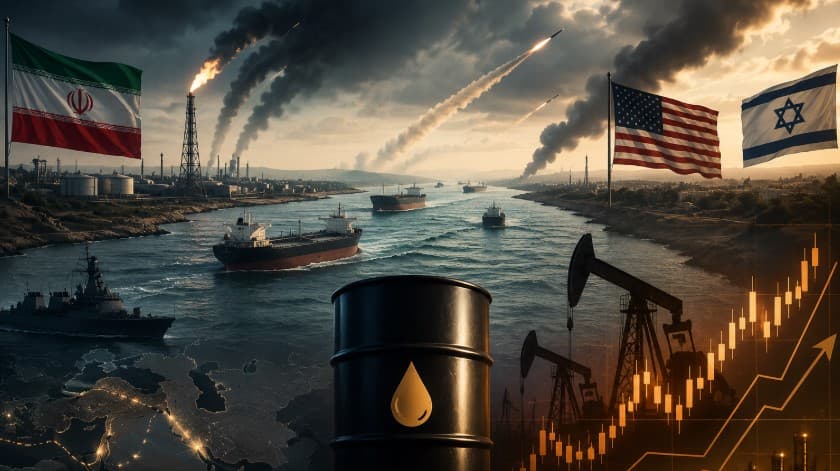
When Donald Trump dismissed Iran's peace proposal as "totally unacceptable" on Monday, global oil markets responded within minutes. Brent crude surged 4.1% to $105.50 a barrel in Asian trade, a sharp signal that energy investors see no near-term resolution to a conflict that has already rewritten the rules of global energy supply.
This is not simply a diplomatic setback. The rejection exposes a deep structural fracture between Washington's demands and Tehran's red lines, with consequences rippling far beyond the Persian Gulf.
How the Diplomatic Breakdown Unfolded
Iran transmitted its response through Pakistan, which has served as a back-channel mediator since the war began on 28 February 2025. Tehran's terms were clear: an immediate end to hostilities and binding guarantees against future US-Israeli military strikes on Iranian territory.
Washington's position, reported by Axios, rested on two non-negotiable demands. First, full restoration of free maritime transit through the Strait of Hormuz. Second, a complete suspension of Iranian nuclear enrichment activities.
Israeli Prime Minister Benjamin Netanyahu went further, stating publicly that the war would not end until Iran's enriched uranium stockpiles were physically "taken out." The gap between these positions is not a negotiating distance. It is a conflict between fundamentally incompatible national survival narratives.
The Strait of Hormuz: A Chokepoint Under Siege
The Strait of Hormuz carries approximately one-fifth of all global oil and gas shipments. Since Tehran threatened to attack vessels attempting to cross the waterway in retaliation for US-Israeli strikes, the strait has been effectively closed. That closure has fractured energy supply chains that the global economy spent decades building around uninterrupted Persian Gulf flows.
Brent crude had already climbed back above $100 a barrel following a brief ceasefire announced in early April. Trump extended that truce indefinitely on 21 April, buying time for diplomacy. The public rejection of Iran's proposal, however, signals that the window for a negotiated reopening of Hormuz is narrowing.
Energy Markets and the Asymmetry of Gain
Who Benefits and Who Absorbs the Pain
The conflict has produced a stark asymmetry in economic outcomes. For major integrated energy companies, soaring prices have delivered windfall profits. Saudi Aramco reported a 25% jump in earnings during the first quarter of 2025 compared to the same period a year earlier.
Aramco's cross-country pipeline network, bypassing the Gulf entirely, has emerged as a critical alternative supply route. CEO Amin Nasser described it as a "critical supply artery" during this period of unprecedented shipping disruption.
For oil-importing economies, particularly India and emerging markets across Asia and Africa, the picture looks entirely different. Sustained crude prices above $100 translate into imported inflation, weakening currencies, and pressure on government subsidies.
The Geopolitical Risk Premium Is Now Structural
Analysts who previously treated Middle East risk premiums as temporary spikes are reconsidering that framework entirely. The longer the Strait of Hormuz remains restricted, the more permanently global supply chains reroute away from Gulf dependency. That structural shift, once accelerated, is difficult to reverse.
Trump's rejection, delivered via social media rather than formal diplomatic channels, signals that structured negotiations remain fragile and subject to abrupt reversal.
What Comes Next: Three Scenarios
Three scenarios now dominate energy market forecasting.
- Renewed diplomacy: Intermediaries such as Pakistan, Oman, or Qatar broker a compromise framework that avoids the nuclear enrichment sticking point and allows partial restoration of Hormuz transit.
- Prolonged stalemate: The ceasefire holds but the strait remains restricted, keeping Brent crude elevated above $100 for an extended period and deepening inflationary pressures globally.
- Escalation: A breakdown in the truce triggers renewed military activity, pushing crude prices toward historic levels and destabilizing regional economies dependent on Gulf stability.
Netanyahu's insistence on eliminating Iran's enriched uranium stockpiles leaves Tehran with very limited room to accept any settlement without appearing to have surrendered its core deterrence posture.
The Bigger Strategic Calculation
What this diplomatic rupture confirms is that the Iran-US-Israel conflict has moved beyond tactical military exchanges. It has become a contest over core strategic assets: nuclear capability, regional deterrence architecture, and control over the world's most consequential energy corridor.
Oil markets are no longer pricing in temporary disruption. They are pricing in the possibility that a new permanent geography of Middle East conflict is taking shape. For policymakers, energy planners, and investors worldwide, the conclusion is the same. The Strait of Hormuz can no longer be treated as a reliable constant in global energy planning.