

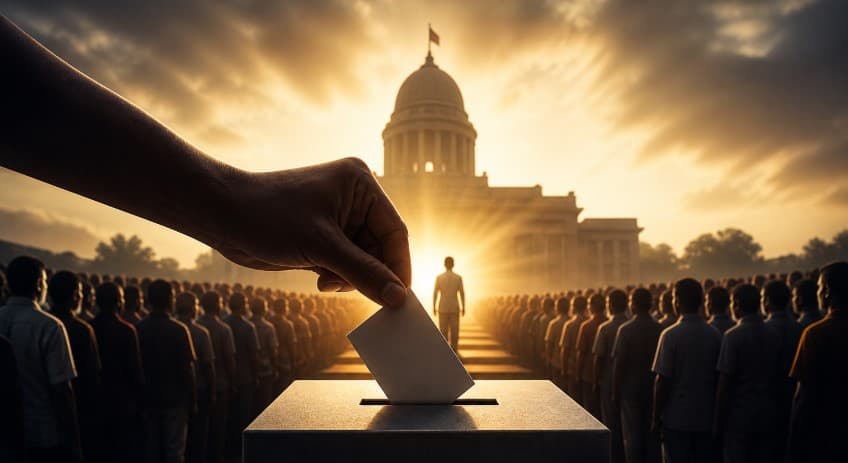
When the election in Tamilnadu Assembly Constituency 185 – Tiruppattur ended with a margin of exactly one vote, it did not just declare a winner. It delivered the most powerful civics lesson of our time.
Winner Seenivasa Sethupathy R Tamilaga Vettri Kazhagam 83,375 | Runner-up Periakaruppan KR Dravida Munnetra Kazhagam 83,374 |
1 vote margin
Imagine you decided to sleep in on election morning. It was hot. The queue looked long. Your favourite team had a match in the evening. So you stayed home, just this once. Now imagine that the election in your constituency was decided by a margin of one single vote. Not a hundred. Not ten. One.
This is not a hypothetical. This is exactly what happened in Assembly Constituency 185, Tiruppattur. When the votes were tallied, Seenivasa Sethupathy R of the Tamilaga Vettri Kazhagam had won with 83,375 votes. His opponent, Periakaruppan KR of the Dravida Munnetra Kazhagam, had polled 83,374. The margin of victory: one vote. A single, solitary ballot separated a winner from a runner-up, a legislator from a private citizen, governance from opposition.
In over 75 years of Indian democratic elections, it is rare for a result this close to emerge. And yet, here it is: proof, undeniable and permanent, that every single vote counts.
"Somewhere in Tiruppattur, one person cast a ballot and unknowingly changed the course of their constituency's political future. Somewhere else, perhaps, someone did not and they will carry that weight."
India's democracy operates at a breathtaking scale. Nearly one billion registered voters. Millions of polling booths. Hundreds of thousands of candidates across countless constituencies. Against such vastness, it is easy, and dangerously so, to feel like you do not matter. That your lone vote disappears into an ocean of numbers and means nothing.
Tiruppattur just proved otherwise. With surgical precision, this result has exposed the quiet arrogance of voter apathy. Every year, in every election cycle, millions of eligible voters choose not to participate. Surveys show that younger voters are particularly prone to disengagement, deterred by cynicism, inconvenience, or the stubborn belief that "nothing will change." And yet here is a case where one fewer voter in a locality could have flipped the entire outcome. One family where only one parent voted instead of two. One young professional who was "too busy." One student who thought it did not matter this time.
Think for a moment about the ripple effects of a one-vote margin. The representative who enters the legislature carries the weight of lakhs of citizens: their healthcare, their roads, their schools, their livelihoods. The policies that flow from that single seat affect real lives for five years. When we stay home on polling day, we are not simply absent. We are handing over our stake in those decisions to someone else's preference.
In Tiruppattur, around 2 lakhs people voted in this contest. Two candidates stood separated by the width of a single slip of paper. Political scientists often speak about how razor-thin mandates reshape narratives: they keep winners humble, they galvanize opposition, and they ignite communities. A one-vote mandate is perhaps the most democratic outcome imaginable. It means the contest was genuinely even, and that the electorate, every single one of them, truly determined the result.
Across India's history, there have been close elections, but few arrive with this level of stark moral clarity. This result from Tiruppattur is not merely a statistical curiosity. It is a mirror held up to every citizen who has ever shrugged and said, "What difference does my vote make?"
The answer, delivered with mathematical certainty: an enormous difference. The entirety of the difference, in fact.
Democracy does not ask much of its citizens. It does not demand that you run for office, attend rallies, or hold a placard in the sun. It asks, once every few years, that you walk into a polling booth and press a button. That is all. In exchange, it offers you a voice in the architecture of your own life. The people of Tiruppattur showed us that this exchange, one vote for one voice, is not symbolic. It is arithmetic.
The conversation about voter apathy must move beyond statistics and slogans. It must become personal. If you did not vote in the last election, ask yourself this: were you that one vote? Were you the margin? You may never know. And that uncertainty, that possibility, is something no citizen in a democracy should be comfortable sitting with.
Your vote is not a drop in the ocean. It is the ocean.
The next time an election arrives, whether municipal, state, or national, remember Tiruppattur. Remember that 83,375 vs 83,374 is not an abstraction. It is real people, real ballots, and one irreversible outcome. Register. Show up. Vote. Because the one vote that changes everything might be yours.