

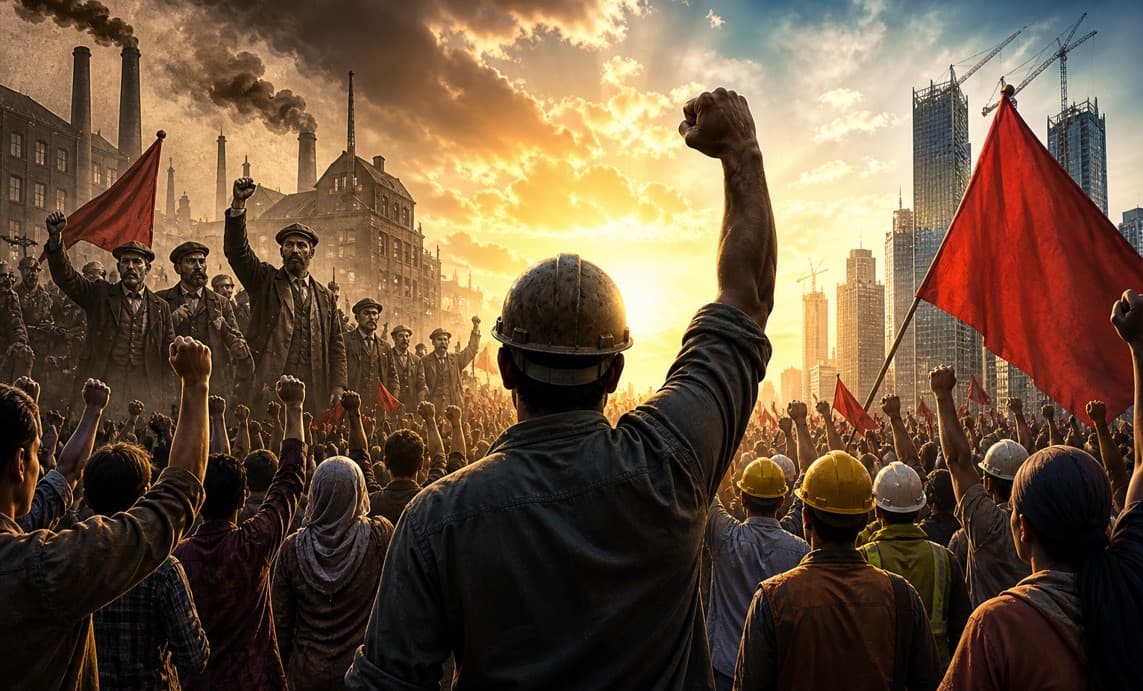
"The eight-hour day has no more passionate advocate than the worker who has never had it."
-Samuel Gompers, Founder of the American Federation of Labor
One Morning That Changed Everything
Picture this: It's 1886. You wake up at 4 a.m., not because you want to but because the factory demands it. You'll work until 7 p.m., sometimes longer. No overtime. No weekends. No sick leave. Your children work beside you. Your body is the machine's fuel, and when it breaks down, you are simply replaced. Now picture May 1, 2025. Across 160+ countries, workers put down their tools, raise their fists, and take to the streets not in anger alone, but in remembrance. In solidarity. In hope. That journey from exhausted silence to global celebration is the story of Labour Day May 1 and it is one of the most dramatic, blood-soaked, and ultimately triumphant stories in human history.
What Is Labour Day?
Labour Day, also known as International Workers' Day or May Day, is a global holiday observed on May 1st every year to honour the contributions of workers and the labour movement. It is a day of parades, protests, political speeches, and - most importantly reflection on how much the world owes to ordinary working people.
Unlike a festival born from mythology or religion, Labour Day was forged in real streets, real courtrooms, and real sacrifice. It is a holiday with a heartbeat.
The History of Labour Day - Born in Blood and Fire
The 19th Century Worker's Nightmare
To understand why Labour Day May 1 matters, you need to step back into industrial-era America. In the 1800s, there were no labour laws worth speaking of. Factory owners set their own rules. Workers including children as young as seven routinely clocked 14 to 16 hours a day, six or seven days a week, in dangerous, dimly lit conditions.
Injuries were common. Compensation was unheard of. Protests were crushed. And yet, something was stirring.
The Eight-Hour Dream
In the 1860s, labour unions began pushing for a radical idea: an eight-hour workday. Their rallying cry was poetic in its simplicity -
"Eight hours for work. Eight hours for rest. Eight hours for what we will."
The National Labour Union called for this reform in 1866. Progress was painfully slow. By 1884, the Federation of Organized Trades and Labor Unions set a deadline: May 1, 1886 would be the day workers demanded the eight-hour day - or they would strike.
The Haymarket Affair - The Spark That Lit the World
On May 1, 1886, over 300,000 workers across the United States walked off their jobs in a coordinated strike. Chicago was the epicentre.
Three days later, on May 4, a peaceful rally was held at Haymarket Square, Chicago, in support of striking workers at the McCormick Harvesting Machine Company, where police had killed two strikers the previous day. As the crowd began to disperse and police moved in to break up the gathering, someone identity never conclusively proven - threw a dynamite bomb at the officers.
The explosion and ensuing gunfire killed seven police officers and at least four civilians. Dozens more were wounded. In the trial that followed, eight labour leaders were convicted - largely on the basis of their political beliefs rather than solid evidence. Four were hanged. One died by suicide in prison. The remaining three were pardoned in 1893 by Illinois Governor John Peter Altgeld, who acknowledged the trial had been a grave injustice. The Haymarket Affair shocked the world. But instead of crushing the labour movement, it ignited it.
Why May 1 Is Celebrated Worldwide
In 1889, the International Socialist Congress meeting in Paris declared May 1 an international day of solidarity for workers directly in memory of the Haymarket martyrs. By 1891, the date had become an annual global event.
Today, Labour Day May 1 is a public holiday in more than 160 countries, making it one of the most widely observed secular holidays on Earth. From Berlin to Bangkok, from Nairobi to New Delhi, workers gather to march, reflect, and demand continued progress.
The date itself carries meaning: it is a promise that the world has not forgotten what it cost to win even the most basic rights the right to rest, to safe conditions, to fair pay.
Labour Day in India: A Story of Its Own
The First May Day in India: Chennai, 1923
India's Labour Day story is rooted in a port city and a pioneering leader. On May 1, 1923, the Labour Kisan Party of Hindustan organized the first-ever Labour Day celebration in India, in what was then known as Madras - today's Chennai, Tamil Nadu.
The driving force was Comrade Singaravelar (Malai Padam Singaravelu Chettiar), a lawyer-turned-activist who became one of India's earliest communist leaders and labour rights advocates. He organized two simultaneous meetings: one at Triplicane Beach and another at the Madras High Court beach. It was at this historic gathering that the red flag was first hoisted in India as a symbol of the labour movement - a moment that would echo through the country's political history.
Labour Rights in Independent India
After independence, India enshrined several protections for workers in its Constitution and through landmark legislation:
- The Factories Act, 1948 - regulated working hours and safety
- The Minimum Wages Act, 1948 - ensured a legal wage floor
- The Payment of Gratuity Act, 1972 - protected long-term workers
Labour Day May 1 is a gazetted public holiday in most Indian states. It holds special significance in Tamil Nadu, Kerala, Maharashtra, and West Bengal states with strong trade union traditions.
Importance of Labour Day in Today's World
The battles of 1886 may feel distant, but the war is far from over.
- The gender pay gap persists globally, with women earning roughly 77 cents for every dollar earned by men.
- Migrant workers in many countries labour without legal protections.
- In developing nations, child labour still affects an estimated 160 million children (ILO, 2022).
- Burnout, mental health crises, and toxic workplaces are at record highs in the post pandemic era.
Labour Day May 1 is not a relic. It is a reminder that rights won can also be lost and that vigilance is the price of dignity.
Labour Day in the Age of the Gig Economy
Here's a 21st century paradox: the app on your phone that delivers food in 30 minutes is driven by a worker who has no guaranteed wage, no sick leave, no pension, and no employment contract. The gig economy built on platforms like Uber, Swiggy, Zomato, Upwork, and hundreds of others has created a new class of workers who fall through the cracks of traditional labour law. They are "partners," not employees. Flexible, yes. But also unprotected. On Labour Day May 1, gig workers across the globe are increasingly joining marches not just to commemorate the past, but to demand that the future include them. The question of what "worker" means in 2025 is perhaps the most urgent labour question of our time.
Fascinating Facts About Labour Day May 1
- Why does the US celebrate Labour Day in September? After the Haymarket Affair, American authorities deliberately avoided May 1 to suppress its radical associations. In 1894, President Grover Cleveland signed legislation making the first Monday of September the official US Labour Day distancing it from international socialist traditions.
- The eight-hour workday was not universally adopted in the US until 1938, when the Fair Labor Standards Act finally mandated it more than 50 years after workers first demanded it.
- The red flag, now synonymous with socialism and labour movements, was first used as a labour symbol in the 1830s, representing the blood of workers shed in struggle.
- India's first Labour Day was celebrated on May 1, 1923, in Madras (Chennai), organized by Comrade Singaravelar making it one of Asia's earliest formal observances.
- May Day predates the labour movement. Ancient European cultures celebrated May 1 as the festival of Beltane a spring fertility festival. The modern meaning was grafted onto an already symbolic date.
- The International Labour Organization (ILO), established in 1919, was in part a response to the global labour unrest symbolized by May Day.
- In China, Labour Day was historically a week-long "Golden Week" holiday. It was shortened to three days in 2008 but remains one of the biggest travel and retail events of the year.
- Cuba, North Korea, and Russia hold massive state-organized Labour Day parades a tradition that became a showcase of military might during the Cold War.
- The phrase "May Day" used internationally as a distress signal (in aviation and maritime emergencies) has no connection to Labour Day it comes from the French m'aider, meaning "help me."
- Over 80 countries designate May 1 as a national public holiday. Several others observe it unofficially, making it the world's most internationally observed secular holiday.
Conclusion: Workers Built This World. Don't Let the World Forget It.
Every road you drive on, every building you live in, every product you use it was built by hands. Calloused, tired, often underpaid hands. Labour Day May 1 is the one day the calendar insists we remember that. The Haymarket martyrs did not throw that bomb in Chicago. But they paid with their lives for a movement that gave you the weekend, the eight hour day, and the legal right to say "this working condition is unacceptable." The question is not whether Labour Day is relevant. The question is whether we are living up to its promise.
So this May 1, whether you march or pause or simply think spare a moment for every worker who made your life possible. That quiet acknowledgment is how history stays alive.