

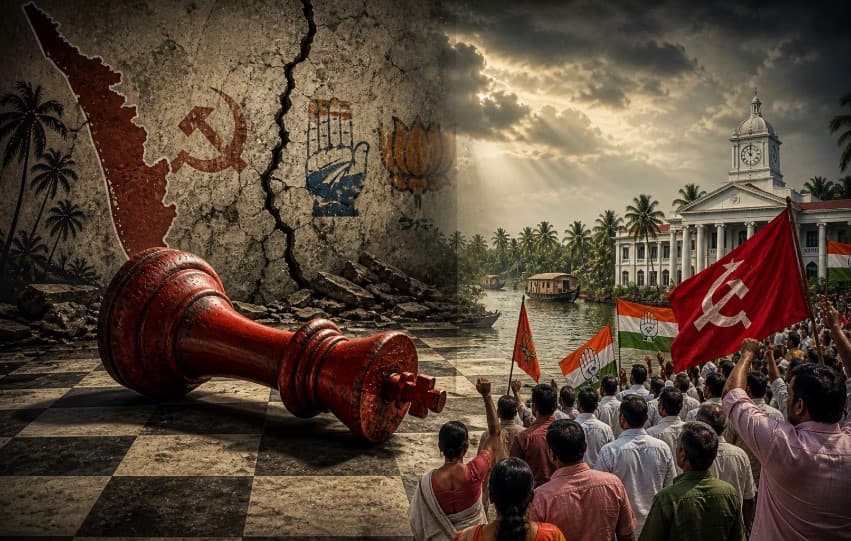
The UDF's 102-seat avalanche did not just end a decade of Left rule. It dismantled the myth of the model communist state, evicted thirteen cabinet ministers from office, and sent the Indian left into its deepest existential wilderness in half a century.
UDF (INC-led)102 ▲ +49 from 2021 | LDF (CPI-M-led)35 ▼ −64 from 2021 | NDA (BJP-led)3 ▲ +2 from 2021 |
INC alone63 seats Rahul Gandhi's Congress | IUML22 seats UDF's anchor ally holds firm | Ministers defeated13 of 21 Staggering cabinet wipeout | UDF's best since2001 Historic 25-year high |
When Pinarayi Vijayan walked into the Thiruvananthapuram press room on the afternoon of May 4 to announce his resignation, the room fell quieter than expected. Not because his defeat was a surprise the trends had screamed it by mid-morning but because what was ending felt larger than one man's tenure. The Left Democratic Front, which had done the impossible in 2021 by winning back-to-back terms and disrupting Kerala's near-sacred alternating pattern, had not merely lost. It had been repudiated. With thirteen of its twenty-one cabinet ministers voted out and the CPI(M) reduced to just 26 seats, the verdict carried the unmistakable weight of a democratic reckoning.
The Congress-led United Democratic Front's 102-seat sweep, its best performance since 2001, is a story about far more than Kerala. It is a story about the outer limits of governance credibility, the stubbornness of voter memory, and the audacity of democratic accountability when citizens decide enough is enough.
The Power of Local Issues vs National Narrative
The LDF entered this election armoured in national optics: a state that had resisted BJP's ideological expansion, a government celebrated internationally for its welfare architecture, and a Chief Minister whose brand was synonymous with crisis management through the 2018 floods and the COVID response. The national media, particularly outlets sympathetic to the Left's intellectual project, reinforced a Kerala-as-model narrative.
But voters in Kottayam, Thrissur, and Alappuzha were not reading those editorials. They were navigating local concerns: a faltering financial position of the state government, the deepening fiscal squeeze on municipalities, land acquisition grievances in the coastal belt, and above all, the creeping sense that a government in its second term had begun to govern for the party rather than for the people. The UDF's campaign slogan "Keralam Jayikkum, UDF Nayikkum" was deliberately provincial. It worked because it spoke to lived experience, not ideological solidarity.
"Kerala did not vote against the Left's ideology today. It voted against the hubris that comes when any government mistakes re-election for a mandate to be infallible."
Political scientists will debate for years whether the 2026 Kerala voter was primarily rational or emotional. The answer, characteristically for this hyper-literate electorate, is that it was both, and strategically so. The swing constituencies that flipped, particularly in central Kerala and parts of Malabar, did not flip out of anger alone. Many of these were constituencies where the UDF had held competitive margins in 2021 and voters had simply tipped marginally toward incumbency. In 2026, the calculus reversed with surgical precision.
The LDF's fatal assumption was that welfarism would insulate it from accountability narratives. It did not account for what might be called the "Kerala paradox": an electorate too educated to be satisfied by welfare alone, demanding simultaneously better services and better governance quality. When allegations of financial mismanagement surfaced in public discourse and several cabinet members became associated with controversy, the credibility gap widened faster than any welfare headline could close it.
Anti-incumbency in Kerala is not a mood. It is a muscle. Voters here have exercised it with clockwork consistency for decades. The real story of 2021 was the anomaly. 2026 is the correction. - Analysis note
Welfare Politics: The Double-Edged Sword
The LDF government's welfare record was genuine: expanded Kudumbashree networks, pension coverage, and robust public health delivery. The UDF's own manifesto, promising "Indira Guarantees," free bus travel for women, and expanded health insurance, acknowledged implicitly that welfare politics is now the permanent baseline of Kerala electoral competition, not an LDF monopoly. Both fronts fought this election on a welfare terrain; the difference was that the UDF promised renewal while the LDF asked voters to trust what already existed.
In a state with Kerala's development indices, the marginal utility of welfare promises decreases. Voters begin weighing governance quality, administrative responsiveness, and above all, trust. Trust, once eroded, cannot be rebuilt by announcing a new scheme. The LDF learned this the hard way.
The Cabinet Massacre: Anti-Incumbency as Precision Strike
The most striking data point from May 4 is not the UDF's tally but the LDF's cabinet casualty list. Thirteen of twenty-one sitting ministers, including heavyweights like V.N. Vasavan and V. Sivankutty, were voted out of their own seats. This is not diffuse anti-incumbency; this is targeted, constituency-level accountability. It suggests that Kerala voters separated their evaluation of the front from their evaluation of individual legislators. Ministers who had become insulated from their constituencies paid the specific, personal price. It is a remarkable demonstration of granular democratic intelligence rarely seen in Indian state elections.
"Thirteen ministers lost their own seats. Kerala did not just change a government. It graded every minister individually and failed most of them. That is democracy functioning at its sharpest."
The BJP's Quiet Milestone and Its Ceiling
For the BJP, three seats represent a meaningful foothold in a state that has historically been inhospitable territory. Rajeev Chandrasekhar's victory in Nemom, the gateway constituency in Thiruvananthapuram, is symbolically significant: the party now has two MLAs in the Assembly for the first time. But the absence of any account in the northern and central regions reveals that the BJP's Kerala project remains urban and coastal in scope. The NDA vote share did not translate into the seat conversion that a genuine breakthrough demands. For now, Thiruvananthapuram remains the BJP's conversation, not its conquest.
Youth, First-Time Voters, and the Impatience Factor
Kerala's youth demographic voted in significant numbers, and the evidence suggests they voted with their impatience. A generation that grew up consuming competitive national and global narratives about economic aspiration, job creation, and administrative transparency had little patience for a government that felt consolidated, even sclerotic, in its second term. First-time voters are historically less bound by community or ideological loyalty, and in constituencies with large youth populations, the swing toward the UDF was sharper. This demographic will be the defining battleground in 2031, and both fronts must reckon with the fact that welfare without economic mobility is an insufficient offer for a generation that watched its peers leave for Gulf jobs or Bengaluru tech parks.
Hidden Patterns: What the Map Reveals
Regionally, the UDF's sweep was total, covering all three geographic zones of Kerala: north, central, and south. The BJP failed to open its account in the north and central regions entirely. The LDF held pockets of resistance in its traditional Kannur-Kozhikode belt and in select constituencies where individual candidate strength trumped the front's overall decline. Pinarayi Vijayan's personal retention of Dharmadam, the sole bright light in an otherwise dark night for the Left, underscored that personal credibility, where it remains intact, can still override front-level disappointment. The LDF's loss was not uniform; it was deepest where governance failures were most locally felt and shallowest where ideological identity remained strongest.
The IUML's 22-seat performance deserves particular attention. The Muslim League, Kerala's most disciplined minority political organisation, delivered cohesively and was a critical pillar of the UDF's numerical architecture. Its consistency provides the Congress with a structural anchor that the LDF lacks; the CPI(M)'s own coalition fragments are increasingly difficult to hold together when the front's overall energy drops.
Winners and Losers Beyond the Seats
Rahul Gandhi emerges as perhaps the single largest non-Kerala beneficiary of this result. The Congress's 63-seat haul, its strongest Kerala performance in a generation, hands him genuine evidence that the party can win states on its own governance alternative pitch, not merely on anti-Modi sentiment. At a moment when the Congress desperately needs proof of vitality between general election cycles, Kerala's verdict is a significant deposit. Conversely, Pinarayi Vijayan, who departs office having governed competently through genuine crises, has his legacy complicated by the scale of the defeat. He broke the alternation pattern in 2021, a genuine achievement; but the 2026 collapse under his watch will require the CPI(M) to introspect honestly, as its own Polit Bureau acknowledged, about whether centralised command-style governance ultimately served the party or the people it claimed to represent.
The real loser, however, may be the Indian Left as an institutional idea. With this defeat, the Left parties have no state government for the first time in nearly five decades, a historic institutional void that raises uncomfortable questions about their long-term relevance in Indian federal democracy.
"The Indian Left now governs no Indian state. For a movement that built its identity on state power, that is not just an electoral loss. It is an existential reckoning."
National Implications: What Kerala Tells Delhi
Three lessons travel beyond Kerala's borders. First, welfare politics has nationalised: no party can distinguish itself on welfare alone; the differentiation must come from governance quality and economic responsiveness. Second, performance-based accountability is not merely a middle-class fantasy; it operates even in highly mobilised, community-driven electorates like Kerala's when the governance deficit becomes sufficiently visible. Third, for the Congress, this result is simultaneously a proof of concept and a warning: winning 63 seats in a two-front state with a strong alliance partner is not the same as building independent national momentum, but it is evidence that the party can still assemble and deliver competitive coalitions.
For Bihar, West Bengal, and the upcoming cycle of state elections, the Kerala playbook matters, especially the UDF's discipline in keeping the anti-incumbency narrative sharp, local, and credible rather than abstract and national.
Critical Takeaways: 2026 Kerala Verdict
01
Kerala's pendulum is back. The 2021 LDF re-election was the historical anomaly; 2026 restores the alternating pattern that has governed state politics since the 1980s.
02
The cabinet wipeout, with 13 of 21 ministers defeated, represents granular individual-level accountability, not just broad anti-incumbency. Kerala voters graded each minister separately.
03
Welfare alone cannot save a government in its second term. Kerala's literate electorate demands governance quality alongside welfare delivery, an increasingly national lesson.
04
The Indian Left now has zero state governments. The CPI(M)'s existential question is no longer electoral. It is institutional: what is the Left for, in a country that has moved beyond its ideological frameworks?
05
The BJP's three-seat milestone conceals a fundamental stagnation. Without penetrating north and central Kerala, the party remains a southern urban footnote rather than a genuine third force.
06
Rahul Gandhi's Congress needed a visible state victory. It has one. The 63-seat haul gives the party proof of organisational relevance and coalition management capacity between general elections.
07
The IUML's 22-seat consistency is the UDF's silent structural advantage. Minority consolidation within a disciplined alliance partner is not a liability; in Kerala, it is the mathematics of governance.
08
Youth and first-time voters swung decisively toward change. Any party that mistakes development metrics for youth satisfaction without addressing employment and aspiration will face this penalty again.
Democracy in Kerala has always been a high-maintenance exercise: demanding, vigilant, and surprisingly unsentimental. When it punishes, it does so thoroughly. Not thirteen cabinet ministers defeated, but thirteen individual verdicts on thirteen individual performance records. When it rewards, it demands the winner remember what the loser forgot: that electoral mandates are not blank cheques, but conditional agreements between the governed and those who seek to govern. The UDF has its 102 seats. What it does with them will be Kerala's next test of the principle that brought them here. Power is borrowed, not owned, and the lender always comes back to collect.