

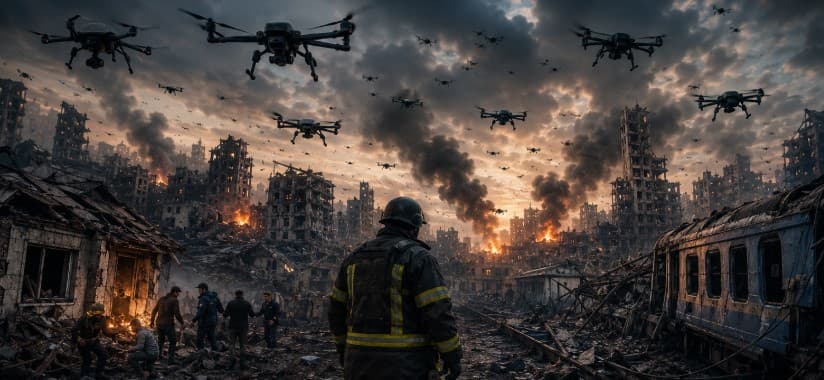
Eight hundred drones, six confirmed deaths, and fourteen regions struck. What Russia's immediate post-ceasefire assault reveals about its strategic calculus, and why the window for peace is narrower than ever.
800+ Drones Launched | 14 Regions Targeted | 6 Confirmed Deaths | 3 Day Ceasefire Duration |
Russia's drone campaign against Ukraine did not pause for reflection after a three-day US-brokered ceasefire expired on Monday. Within hours of the truce's end, Moscow launched what Ukrainian President Volodymyr Zelensky described as an 800-drone barrage across fourteen Ukrainian regions, killing at least six people and wounding many more. The scale and speed of resumption stripped away any remaining ambiguity about Russia's intentions, and handed the international community an unambiguous signal: Moscow views temporary ceasefires as operational pauses, not genuine openings for diplomacy.
What Happened: A Full Reconstruction
The attacks began almost immediately after the ceasefire window closed late Monday. Ukraine's air force reported 139 drones in an overnight first wave, followed by a daytime surge of 753 drones launched between 08:00 and 18:30 local time on Wednesday alone. While Ukrainian air defenses intercepted a significant number, 27 struck their targets directly and debris from 26 more caused secondary damage on the ground.
The toll spread across the country. In the Rivne region, a residential house took a direct hit, killing three and wounding four. Kherson saw at least 20 wounded across multiple strikes. An elderly man died in Zaporizhzhia when a Russian guided bomb detonated nearby. The Dnipropetrovsk region recorded more than 30 attacks across three districts on Tuesday alone, with eight deaths and 11 wounded. Russia also struck the far western Zakarpattia region, bordering Slovakia, prompting Bratislava to close its land border crossing indefinitely for security reasons.
Ukrainian military intelligence agency Hur warned that the drone strikes appeared designed to saturate and overload air defenses, potentially setting the stage for a follow-on wave of heavier missile strikes. That two-phase doctrine, wear down the shield, then pierce it, reflects a pattern Russia has applied repeatedly across the war.
"Russia launched 800 drones in a single day after a ceasefire that lasted 72 hours. That is not a peace signal. That is a demonstration of sustained capacity."Strategic Review Analysis
Why This Matters Strategically
The Ceasefire as a Tactical Tool
The three-day truce brokered with US involvement was framed publicly as a humanitarian gesture. In practice, both sides reported violations along the frontline throughout its duration. No major aerial attacks occurred during the 72 hours, but the moment it expired, Russia's response was overwhelming and immediate. This pattern should reshape how analysts and policymakers interpret future ceasefire proposals. For Moscow, a temporary halt provides logistical breathing room, drone inventory replenishment, and positive optics in international forums, without any binding concession on territory or military posture.
The Slovakia Factor: Conflict Reaches NATO's Doorstep
Russia's decision to strike Zakarpattia, Ukraine's westernmost region sharing a border with NATO-member Slovakia, carries significant escalatory weight. Slovakia's immediate closure of the border crossing is the most concrete and visible spillover effect the war has produced in Central Europe since 2022. Whether deliberate messaging or tactical opportunism, the strike demonstrated that Russia's drone reach now comfortably extends to regions immediately adjacent to the EU's Schengen zone.
Strategic Risk Indicators
Ukraine's Hur intelligence assessed the drone campaign as potentially "protracted," a word choice that signals this is not a temporary surge but a settled operational strategy. Key risks include:
- Air defense attrition: sustained 800-drone days can deplete interceptor stocks faster than resupply cycles
- Civilian infrastructure collapse: Zelensky specifically cited railway infrastructure as a deliberate target
- Western alliance fatigue if drone waves continue without a clear diplomatic horizon
- Slovakia border closure disrupting humanitarian and logistics routes into western Ukraine
- Missile escalation: Hur explicitly warned that drone saturation could precede a heavy missile wave
Ukraine's Counter-Campaign and Russia's Domestic Exposure
The conflict has become genuinely bilateral in its aerial dimension. Russia's defense ministry reported intercepting 286 Ukrainian drones over 14 Russian regions and Crimea since Tuesday evening. Ukrainian strikes hit industrial facilities in Krasnodar, Yaroslavl, and a gas processing plant in Astrakhan. Kyiv's consistent framing is that energy and industrial infrastructure supporting Russia's war production are legitimate military targets under international law.
The Belgorod border region reported one Russian civilian death from a Ukrainian drone strike. This is not an anomaly. Ukraine has intensified strikes on Russian energy infrastructure systematically over recent months, turning Russia's own territory into a secondary theater of the conflict. The domestic political pressure this creates for the Kremlin, even in a controlled information environment, should not be discounted entirely.
The Diplomatic Deficit
The US brokered the ceasefire, but Washington's leverage over Russia's operational decisions appears limited. The rapid return to mass drone warfare suggests Russia calculated that the diplomatic cost of resuming attacks was negligible compared to the military and psychological benefit of continuous pressure. Zelensky's accusation that Russia is "purposely" targeting civilian railway infrastructure reflects Kyiv's understanding that the attacks serve a dual function: tactical attrition of military logistics and strategic demoralization of the civilian population.
For the broader international community, the post-ceasefire assault presents a test of cohesion. If 800 drones launched within hours of a truce expiring does not produce a coordinated diplomatic response, Russia has effectively established a template for how it will handle future negotiated pauses.
Forward Outlook: What Comes Next
Ukraine's air force and intelligence are signaling that the current tempo may be a precursor, not a peak. The doctrine of drone saturation followed by missile strikes has been used before. If Hur's assessment is accurate, Ukraine faces the prospect of a compound attack sequence that its air defense network, even substantially reinforced by Western systems, will find difficult to absorb simultaneously.
The border closure by Slovakia is likely to be a temporary administrative measure, but it will test EU solidarity and could complicate supply corridor logistics. Any sustained disruption to Ukraine's rail and border infrastructure, which Russia appears to be deliberately targeting, would carry cascading consequences for humanitarian operations, military resupply, and civilian displacement management.
What the events of May 13 and 14, 2026 confirm is that Russia views the current phase of the war as an opportunity to impose maximum pressure while international attention is fragmented. The strategic question for Ukraine's partners is no longer whether Russia intends to negotiate in good faith in the near term. The evidence answers that. The real question is what combination of military support, air defense reinforcement, and diplomatic coordination can alter Russia's cost-benefit calculus before the next ceasefire offer becomes another tactical interlude.