

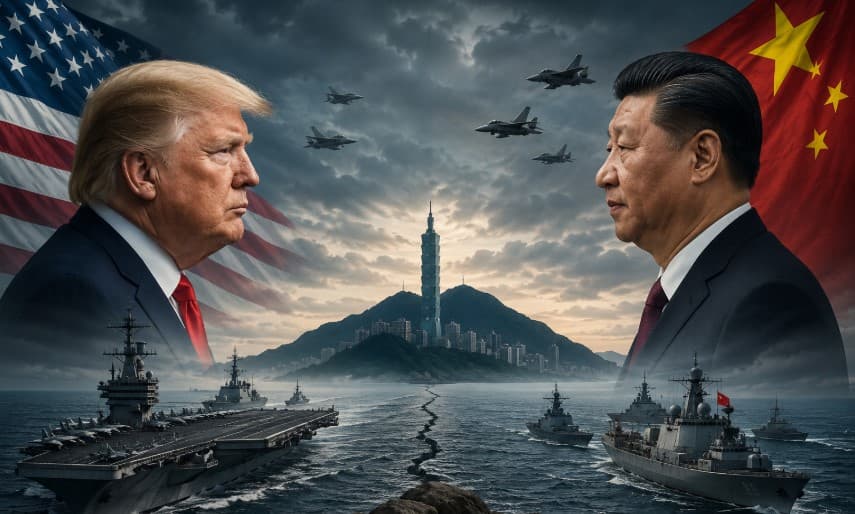
From decades of strategic ambiguity to a new transactional era Donald Trump's blunt caution to Taiwan, delivered hours after a bilateral summit with Xi Jinping, signals a seismic recalibration that could redraw the rules of the Indo-Pacific.
The Warning That Shook the Taiwan Strait
When Donald Trump told Fox News he was "not looking to have somebody go independent," he was not speaking casually. Those words, delivered within hours of a two-day summit with Chinese President Xi Jinping in Beijing, carried the full weight of American policy recalibration toward the most explosive territorial dispute on the planet. Trump's warning to Taiwan against declaring formal independence is the clearest signal yet that Washington's approach to the Taiwan question is shifting from strategic ambiguity to strategic transaction.
What Happened: The Beijing Summit and the Taiwan Signal
Trump's remarks came at the close of a bilateral summit in Beijing where Taiwan dominated the conversation. According to Chinese state media, Xi told Trump directly: "The Taiwan question is the most important issue in China-US relations." Trump confirmed that he and Xi discussed the island "a lot" and that Xi "feels very strongly" and "doesn't want to see a movement for independence." Trump added that he had declined to confirm whether the US would militarily defend Taiwan a departure from the more assertive posture his own administration had previously implied.
"We're supposed to travel 9,500 miles to fight a war. I'm not looking for that." — Donald Trump, Beijing, 2026
The summit also left a key question hanging: an $11 billion arms sale to Taiwan, announced by the Trump administration itself late last year, including advanced rocket launchers and missiles. Trump said a decision on whether that sale would proceed was imminent a decision Beijing has condemned and Taipei has called a cornerstone of regional stability.
What Happened Before: Decades of Strategic Ambiguity
1979
The US switched diplomatic recognition from Taipei to Beijing, passing the Taiwan Relations Act legally binding Washington to provide Taiwan with means of self-defence.
1996
China fired missiles near Taiwan during its presidential elections; the US deployed two carrier groups the last direct show of force in the Strait.
2022–25
China dramatically increased military drills around Taiwan, including large-scale encirclement exercises that tested Taipei's defences and Washington's resolve.
Feb 2025
The US State Department quietly removed language opposing Taiwanese independence from its website a move Beijing called a "wrong signal to separatist forces."
Late 2025
Trump approves an $11 billion arms package for Taiwan; Beijing condemns it as interference in Chinese internal affairs.
Policy Context
Taiwan's President Lai Ching-te has consistently stated that Taiwan does not need to declare formal independence because it already considers itself a sovereign nation a position Beijing labels separatist. Most Taiwanese favour maintaining the current status quo: neither unification nor formal independence.
Why It Matters: The Transactional Shift in US-Taiwan Policy
For decades, Washington maintained deliberate ambiguity never confirming whether it would militarily defend Taiwan, never endorsing independence, never abandoning the island either. This balance, frustrating to all sides, preserved an uneasy peace. Trump's approach is fundamentally different. His comments suggest a transactional calculus: Taiwan's security is increasingly a variable in a broader US-China negotiation, one that includes trade, technology, fentanyl, and the South China Sea.
Taiwan's Deputy Foreign Minister Chen Ming-chi acknowledged the need to "clarify the exact meaning of Trump's remarks" diplomatic language for serious unease in Taipei. A spokesperson for President Lai was quick to reaffirm that US arms sales represent an American "security commitment" and serve as "a shared deterrent against regional threats."
Strategic Implications for the Indo-Pacific
Trump's signal carries consequences far beyond the Taiwan Strait. Japan, South Korea, Australia, and the Philippines — all reliant on the credibility of US security guarantees are watching closely. If Washington appears willing to negotiate Taiwan's status as a bargaining chip, it erodes the foundational assumption of the entire US-led alliance architecture in Asia. China, meanwhile, interprets ambiguity as opportunity. Beijing has not ruled out taking Taiwan by force, and any perceived softening of US resolve historically emboldens rather than restrains Chinese military planning.
Key Strategic Takeaways
✓Trump's warning signals a shift from strategic ambiguity to open transactionalism on Taiwan.
✓The $11 billion arms sale decision will serve as the immediate litmus test for US commitment to Taipei.
✓US allies across Asia face renewed uncertainty about the reliability of American security guarantees.
✓Beijing frames the Taiwan question as the central issue in all US-China relations a position Trump implicitly accepted by placing it first.
✓Taiwan's domestic political response will shape how Taipei navigates an increasingly uncertain Washington relationship.
What Comes Next: The Road Ahead for Taiwan
The immediate flashpoint is the arms sale. If Trump proceeds, it signals that despite his conciliatory language, the structural US commitment to Taiwan's defence remains. If he delays or conditions the sale on Chinese economic concessions, it marks a historic departure — one that Beijing would register as a major diplomatic win and Taiwan as a strategic betrayal. Beyond the sale, the broader risk is normalization: a world where Taiwan's security is openly traded in global dealmaking establishes a precedent that resonates from Seoul to Vilnius.
Taiwan's Foreign Minister Lin Chia-lung called Taiwan a "guardian of peace and stability" and accused China of escalating risk through "aggressive military actions." That framing reflects Taipei's consistent strategy: present itself as the responsible actor while quietly lobbying Washington to hold firm. Whether that strategy survives a second Trump term defined by bilateral deal-making remains the central question of Indo-Pacific security in 2026.