

Introduction
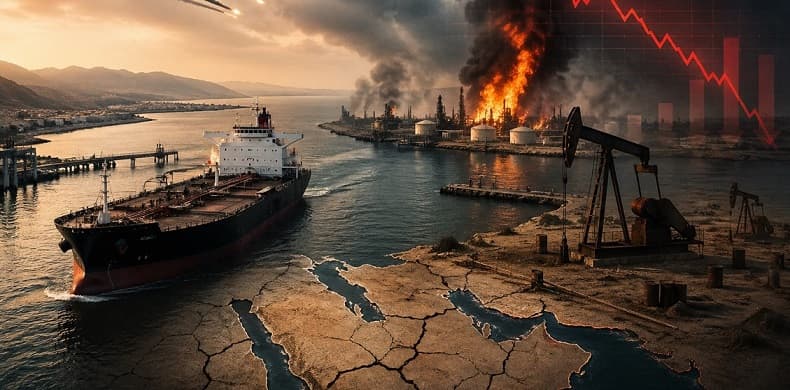
The world's most critical energy corridor is under threat. As conflict escalates across the Middle East, the Strait of Hormuz, the narrow waterway through which roughly one-fifth of global oil flows, faces unprecedented disruption, triggering what analysts are now calling the Gulf economic crisis 2026. From damaged refineries to rerouted tankers, the economic shockwaves are reverberating far beyond the Gulf's borders. Gulf Cooperation Council (GCC) nations, which had only recently recovered from pandemic-era downturns, now face sharply revised growth forecasts, surging inflation, and mounting uncertainty over energy revenues. The stakes could not be higher: what happens in the Gulf shapes energy prices, trade routes, and economic stability worldwide.
What Is the Gulf Economic Crisis 2026?
The Gulf economic crisis 2026 is a multi-layered economic shock rooted in active military conflict near key energy infrastructure across the Persian Gulf region. Unlike previous downturns driven purely by oil price cycles or demand collapses, this crisis is supply-side in origin and far more structurally damaging.
Conflict has disrupted shipping lanes, damaged refinery capacity, and created a climate of investment withdrawal across the GCC. Insurance premiums for tankers traversing the region have surged. Foreign workers and business travelers are exiting key hubs. The combination of supply shock and investor flight is reminiscent, in scope if not in exact cause, of the 1970s Arab oil embargoes that sent Western economies spiraling into stagflation.
What makes 2026 different is the degree of physical infrastructure damage. Refineries in the northern Gulf have sustained strikes, reducing processing capacity just as global demand was expected to rise. Supply chain interconnections from petrochemicals to liquefied natural gas have been severed or severely delayed. The economic fallout is no longer hypothetical: it is being measured in revised GDP forecasts, emergency budget revisions, and diplomatic emergencies at the highest levels.
Why the Strait of Hormuz Is Critical to Global Energy
The Strait of Hormuz is arguably the single most important choke point in global energy supply. Its strategic importance cannot be overstated:
- Approximately 20% of global oil supply transits the Strait daily, including crude exports from Saudi Arabia, Iraq, Iran, Kuwait, and the UAE.
- LNG exports from Qatar among the world's largest pass exclusively through this waterway, making global gas markets directly exposed to any disruption.
- No cost-effective alternative route exists at scale. While Saudi Arabia operates the East-West Pipeline to bypass the Strait, its capacity covers only a fraction of normal export volumes.
- Tanker traffic disruption immediately translates into spot price spikes, shipping delays, and supply shortfalls for energy-dependent economies in Asia and Europe.
- Geopolitical leverage concentrated here means even the threat of closure sends shockwaves through financial markets and energy contracts worldwide.
In short, the Strait of Hormuz is the jugular of global energy, and war has placed a finger on it.
GCC Countries Facing Economic Contraction
The Gulf economic crisis 2026 has delivered a brutal reversal for GCC nations that had, just months earlier, been projecting confident growth. Updated GDP forecasts paint a stark picture:
Qatar is among the hardest hit, with forecasts now pointing to a contraction of approximately −6.0%. As one of the world's premier LNG exporters, Qatar's revenues are acutely exposed to any inability to ship through the Strait. Export halts translate almost directly into GDP loss.
Kuwait faces a projected contraction of −4.4%, reflecting its near-total dependence on oil revenue and the shutdown of northern Gulf tanker routes. With limited sovereign diversification compared to the UAE, Kuwait's fiscal buffers are being tested rapidly.
Bahrain, the smallest GCC economy and most dependent on regional stability for financial services, faces a contraction of −2.9%. Its banking sector, already under pressure, is seeing capital outflows as regional uncertainty deepens.
The UAE, previously a beacon of Gulf diversification success, now faces near stagnation rather than the 4–5% growth it had expected. Dubai's trade and logistics model is uniquely vulnerable to shipping disruption, and tourism arrivals have plummeted.
Saudi Arabia still benefits from Aramco's scale and the East-West Pipeline bypass option, but growth expectations have been slashed. Vision 2030 megaprojects face funding pressure as oil revenue falls short of budget projections.
Across the GCC, the common thread is simple: war-related disruption to the Strait of Hormuz strikes at the revenue engine that powers every government balance sheet in the region.
Impact on Global Oil Prices and Energy Markets
The global energy market has responded to the Gulf economic crisis 2026 with extreme volatility. Oil prices have surged by approximately 40% from pre-crisis levels, driven by the following converging pressures:
- Supply shock: Reduced export capacity from the Gulf, combined with physical damage to refining infrastructure, has removed millions of barrels per day from the market.
- Shipping disruption: Tanker operators are avoiding the Strait or demanding war-risk premiums, adding $5–$10 per barrel to delivery costs on affected routes.
- Refinery damage: Strikes on refinery infrastructure mean that even crude oil that reaches export terminals cannot be processed into usable fuel products efficiently.
- Inventory drawdowns: Strategic petroleum reserves in the US, Europe, and Asia have been tapped, providing temporary relief but with finite capacity.
Historically, oil shocks of this scale, comparable in some respects to the 1973 embargo and the 1979 Iranian revolution, have reliably triggered global recessions. The key difference today is the speed of market transmission: algorithmic trading and globally integrated supply chains amplify shocks in hours, not weeks.
Effects on Tourism, Retail, and Non-Oil Sectors
One of the most visible and underreported dimensions of the Gulf economic crisis 2026 is the collapse of the non-oil economy, which GCC governments had spent years trying to build as a buffer against exactly this kind of energy shock.
Tourism has been devastated. International arrivals to Dubai, Abu Dhabi, and Riyadh have fallen sharply as flight insurance premiums rise, travel advisories are issued by major economies, and leisure travelers choose safer destinations. The hospitality, retail, and MICE (meetings, incentives, conferences, exhibitions) sectors are contracting rapidly.
Retail and consumer spending are weakening as expat populations who form a significant share of the consumer base in UAE and Qatar reduce expenditure or prepare to exit the region entirely. Business sentiment surveys show the sharpest drop in investment intentions in over a decade.
Vision 2030-aligned projects in Saudi Arabia face headwinds as foreign investment commitments stall. Construction timelines are extended, joint venture discussions are paused, and technology partnerships are deferred. The diversification decade that Gulf leaders had promised is now under direct threat.
Inflation Risks Across Gulf Countries
While Gulf states have historically insulated citizens from global price pressures through fuel subsidies and fixed-price utilities, the scale of the current disruption is testing those defenses.
Inflation is rising across the board:
- UAE is experiencing rising consumer prices driven by imported goods inflation, as shipping costs feed through to retail prices.
- Kuwait and Qatar face fuel-related input cost pressures even domestically, as refinery disruption affects local supply chains.
- Bahrain, with the least fiscal space, faces the sharpest cost-of-living pressures, particularly for lower-income expat workers.
Governments are caught between maintaining subsidy regimes (expensive) and allowing price pass-through (politically risky). The result is mounting fiscal pressure precisely when oil revenues are declining a dangerous combination that risks widening budget deficits across the region.
Recovery Outlook for 2027
Despite the severity of the current Gulf economic crisis, most economists believe recovery is possible in 2027, but the timeline depends almost entirely on one variable: when, and how, the conflict ends.
Best-case scenario: A negotiated ceasefire in H2 2026 restores Strait of Hormuz navigation by early 2027. Gulf GDP rebounds 4–6% as pent-up investment returns, oil revenues recover, and infrastructure rebuilding stimulates domestic spending. Sovereign wealth funds, particularly Abu Dhabi's ADIA and Saudi Arabia's PIF, provide the fiscal bridge.
Moderate scenario: Conflict winds down slowly through 2026–2027, with partial shipping restoration. Gulf economies recover to flat-to-modest growth by late 2027, with lingering investor wariness keeping capital inflows below pre-crisis levels.
Worst-case scenario: Prolonged conflict extending into 2027–2028 causes permanent infrastructure damage, accelerates foreign business exodus, and forces fiscal austerity across GCC states. Recovery is pushed to 2028–2029, with some structural damage that cannot be fully reversed.
Government reserves, particularly in the UAE, Qatar, and Saudi Arabia, provide meaningful fiscal runway in the near term. But these buffers are not unlimited, and every quarter of continued disruption narrows the margin for a smooth recovery.
Global Economic Implications
The ripple effects of the Gulf economic crisis 2026 extend far beyond the GCC's borders. The world's most energy-dependent economies are absorbing collateral damage in real time.
Asia is most acutely exposed. Japan, South Korea, China, and India collectively import billions of dollars in Gulf energy annually. Higher oil prices are feeding directly into industrial production costs, consumer price indexes, and trade balances across the continent. Central banks in the region are being forced to choose between fighting imported inflation and supporting slowing growth.
Europe faces a double pressure: energy import costs are rising as Gulf LNG supplies fall short, while the global slowdown is dampening demand for European exports. The European Central Bank faces a stagflationary bind reminiscent of the post-2022 energy crisis.
Global shipping and logistics are being restructured in real time. Longer rerouting via the Cape of Good Hope adds 10–14 days and 20–30% to freight costs for Gulf-origin cargoes. These costs are eventually absorbed by consumers worldwide.
The bottom line: the Gulf economic crisis 2026 is not a regional problem. It is a global supply shock with consequences for inflation, trade, and economic growth in every major economy.
Future Risks and Possible Scenarios
Beyond the immediate GDP and inflation data, several deeper risks are worth tracking:
Extended war risk: The longer conflict persists, the more permanent the economic damage. Investors, multinationals, and skilled workers who exit the region do not always return quickly, even after peace is restored.
Long-term supply damage: Physical infrastructure, including refineries, pipelines, and export terminals, takes years to rebuild. Production capacity lost in 2026 may not be fully restored until 2028 or beyond, creating a structural supply gap.
Energy market restructuring: The crisis is accelerating investment in alternative energy supply chains. LNG terminals in the US, Australia, and East Africa are receiving increased capital commitments. In the medium term, Gulf producers may face a more competitive global energy landscape as a result.
Geopolitical realignment: The crisis is reshaping diplomatic alignments. Countries previously neutral are being pushed to take sides, adding new complexity to post-conflict reconstruction and trade normalization.
Key Takeaways From the Gulf Economic Crisis
- War has directly disrupted global oil supply through physical damage and navigation risk in the Strait of Hormuz, triggering an energy supply shock of historic proportions.
- Gulf GDP growth is reversing sharply, with Qatar, Kuwait, and Bahrain facing outright contraction and even the UAE and Saudi Arabia recording near-stagnation.
- Inflation pressures are rising across GCC states and rippling outward to energy-importing economies in Asia and Europe.
- Recovery depends fundamentally on conflict resolution government reserves provide a buffer, but not an indefinite one.
- Global energy markets remain highly volatile, with oil prices up approximately 40% and further moves possible depending on the conflict trajectory.
- Non-oil diversification efforts, the signature economic ambition of the GCC's pre-crisis decade, are now under serious threat as foreign investment retreats.
Conclusion
The Gulf economic crisis 2026 is one of the most serious economic disruptions the region and the world have faced since the COVID-19 pandemic. It is fundamentally different from previous downturns because it is a war-driven supply shock that simultaneously attacks oil revenues, shipping infrastructure, investor confidence, and consumer activity across GCC economies. The human and economic costs are real, rising, and interconnected.
For Gulf governments, the immediate challenge is managing fiscal deficits and maintaining stability. For the global economy, the challenge is absorbing an energy supply shock without tipping into recession. For policymakers everywhere, the lesson is stark: the Strait of Hormuz is not just a waterway: it is an economic lifeline, and its disruption is a global emergency.
Resolution of the conflict remains the single most important variable in any recovery scenario. Until geopolitical stability returns to the region, energy markets will remain volatile, Gulf GDP forecasts will continue to be revised downward, and the full cost of the crisis will remain uncounted.
Stay informed about global economic risks and geopolitical developments to understand how energy markets shape the future economy.