

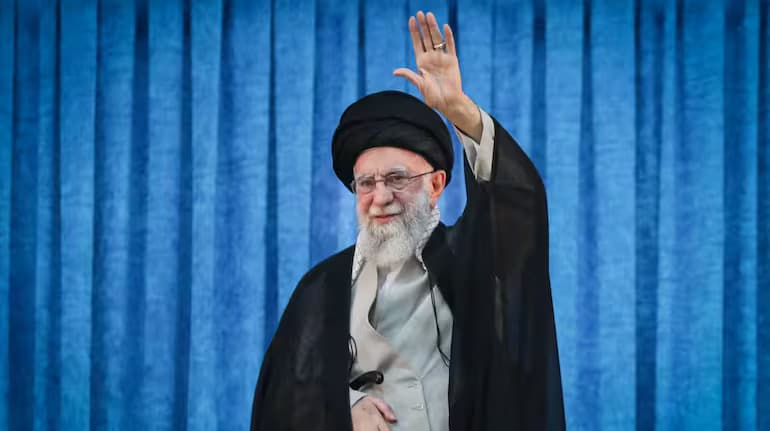
Supreme Leader’s Death Marks Explosive Close to Four Decades of Power
The iron grip of Ayatollah Ali Khamenei, the unyielding supreme leader who shaped Iran's destiny for nearly four decades, has shattered in a blaze of fire and fury. On February 28, 2026, in the opening phase of massive joint US-Israeli air strikes, the 86-year-old cleric was killed in a precision strike on his Tehran compound.
US President Donald Trump announced the death boldly, calling it a decisive blow against tyranny. Iranian state television, its voice cracking with emotion, later confirmed the "martyrdom" of the man who had ruled since 1989.
Iran declared 40 days of official mourning. Yet beneath the tears and black-clad rallies, whispers of quiet celebration ripple through streets long silenced by repression.
This is no ordinary obituary. It is the explosive end of an era, one man's iron rule crumbling under bombs, missiles, and the weight of history he helped forge.
FROM POVERTY TO POWER
Born in 1939 in Mashhad, the second of eight children in a pious Shia family, Khamenei grew up, in his own words, "poor but pious," often surviving on bread and raisins. By age 11, he was a qualified cleric, but his ambitions extended beyond theology.
He became a fierce critic of Shah Mohammad Reza Pahlavi, enduring six arrests, torture, and exile at the hands of the monarch’s feared secret police.
The 1979 Islamic Revolution transformed his fortunes. Ayatollah Ruhollah Khomeini appointed him Friday prayer leader in Tehran. His fiery sermons resonated nationwide, cementing his place in the new Islamic order.
Khamenei backed the 444-day US embassy hostage crisis, an episode that humiliated Washington, doomed President Jimmy Carter’s re-election bid, and entrenched decades of hostility between Tehran and the West.
SURVIVAL AND ASCENT
In 1981, a bomb hidden inside a tape recorder exploded during one of his lectures. Khamenei survived but lost the use of his right arm and spent months recovering from lung injuries.
Later that year, he won the presidency with 97 percent of the vote under Khomeini’s watchful eye. He condemned what he called "deviation, liberalism, and American-influenced leftists," signaling the ideological rigidity that would define his leadership.
As wartime president during the brutal 1980 to 1988 Iran-Iraq War, he spent months at the front lines. He witnessed chemical attacks, missile strikes on Tehran, and Iran’s devastating human-wave tactics. The conflict deepened his enduring distrust of the United States and Western powers, whom he accused of backing Saddam Hussein.
When Khomeini died in 1989, the Assembly of Experts selected Khamenei as supreme leader despite his relatively modest religious scholarship. He acknowledged his "faults and shortcomings" as a "minor seminarian." Over the next 36 years, he would consolidate a formidable and enduring power structure.
THE ARCHITECT OF CONTROL
Khamenei built a tight alliance of hardline clerics and Revolutionary Guard elites. He cultivated a pervasive cult of personality, with his image displayed on billboards, storefronts, and public buildings across the nation. He relied heavily on security forces rather than purely religious authority to maintain control.
Dissent was met with force.
The 1999 student protests were suppressed. The 2009 Green Movement, which challenged a disputed election, was crushed with beatings, shootings, and mass arrests. In 2019, fuel-price protests triggered internet blackouts and lethal crackdowns that left hundreds dead.
The 2022 demonstrations following the death of Mahsa Amini in custody marked one of the most intense challenges to his rule. More than 550 people were killed and 20,000 detained. Women who defied mandatory hijab laws faced torture, solitary confinement, and sentences of up to 38 years and lashes.
REGIONAL STRATEGIST AND GLOBAL ADVERSARY
Abroad, Khamenei expanded Iran’s influence through regional proxies such as Hezbollah. He issued a religious decree, or fatwa, against nuclear weapons, though Western governments accused Tehran of secretly pursuing them.
Sanctions severely damaged Iran’s economy. Khamenei cautiously accepted the 2015 nuclear deal but reacted angrily when President Trump withdrew the United States from the agreement in 2018. He vowed revenge after the 2020 US assassination of Iranian commander Qasem Soleimani.
Escalations intensified. Israeli air strikes in 2025 were followed by Iranian missile barrages and US military threats.
By early 2026, economic collapse fueled renewed unrest. Human rights groups reported at least 6,488 killed and 53,700 detained in protests. President Trump increased US military deployments, demanding Iran abandon its nuclear ambitions.
Khamenei responded defiantly: "If they start a war, this time it will be a regional war."
THE FINAL STRIKE
On February 28, 2026, US-Israeli strikes targeted key Iranian military and leadership sites. Among them was Khamenei’s Tehran compound, which was destroyed in a precision attack.
President Trump described the operation as a triumph against "one of the most evil people in history." Iran retaliated with missiles and drones, striking Israeli and Gulf targets. The exchange of fire continues, with reports indicating that several senior Iranian leaders were also killed.
AN UNCERTAIN FUTURE
As supreme leader, Khamenei served as head of state, commander-in-chief of the armed forces, final arbiter of political decisions, and ultimate authority over candidate selection. Though Iran’s system included competing institutions, his word remained decisive.
For many young Iranians, he was the only leader they had ever known. His portrait was omnipresent. His directives shaped every major policy decision.
Now, Iran awakens without him. A three-person interim council has assumed authority amid ongoing conflict. According to Iran’s foreign minister, a successor could be chosen within days, but wartime uncertainty clouds the process.
Across the region, reactions are divided. In Baghdad and Tehran alike, mourning loyalists gather in public squares while others quietly express hope for change.
Khamenei’s death marks the end of a powerful and polarizing era. Whether it ushers in chaos, reform, or deeper conflict remains uncertain.
The strings he pulled for decades have been cut. His era ends not in quiet succession, but in thunderous explosions that reverberate across history.
Iran, and the world, now stand at a crossroads.