

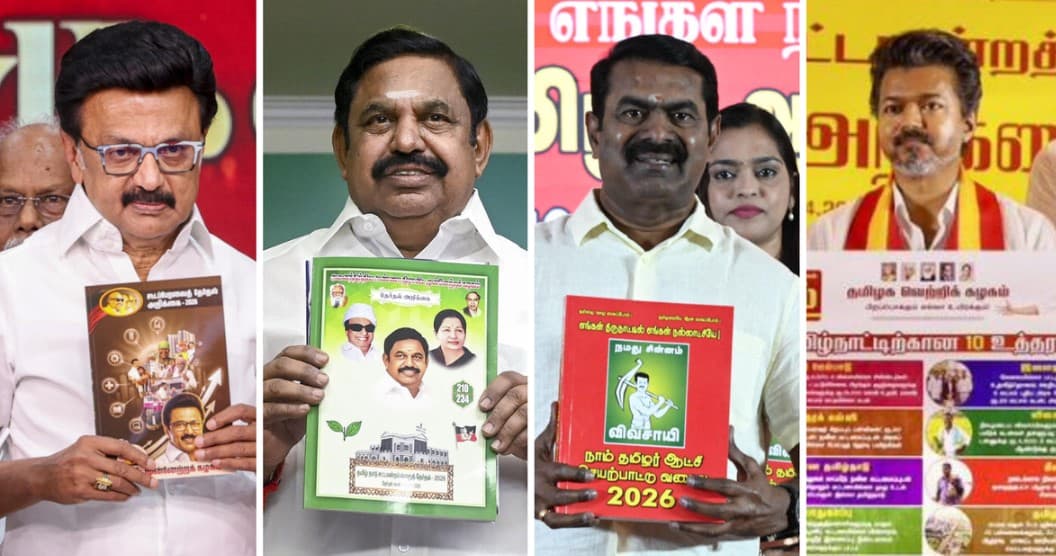
This Tamil Nadu 2026 election manifesto financial analysis examines five major parties, DMK, AIADMK, BJP, TVK, and NTK not for political optics, but for fiscal credibility. With welfare promises that could collectively exceed the state's entire annual revenue, TruthMatters Score asks the question no campaign rally will: Can Tamil Nadu actually afford its own election season?
CHENNAI, With Tamil Nadu's 2026 Assembly elections approaching, five major political formations have entered the promise economy with characteristic ambition. From monthly cash transfers to blanket loan waivers and free household goods, the manifestos collectively propose welfare commitments that, if fully implemented, could rival the state's entire annual revenue receipt. This is not a political scorecard. This is a forensic audit.
THE PROMISE MATRIX
Party | Cash Schemes | Free Goods | Loan Waivers | Welfare Expansion | Capital Projects |
|---|---|---|---|---|---|
DMK | ₹1,000/month women; enhanced Kalaignar Magalir Urimai | Free gas cylinder (4/year), ration goods expansion | Agricultural loan waiver extension | Expanded health insurance, student scholarships | Metro Phase II, highway corridors |
AIADMK | ₹1,500/month women; ₹2,000 farmer support | Free mixer-grinder, fan, gold thali scheme | Farm debt relief up to ₹2 lakh/farmer | Amma Canteen revival, TASMAC-linked welfare | Industrial corridor push |
BJP | PM Kisan top-up (₹8,000 total); senior citizen pension hike | LPG subsidy restoration | MSME loan waiver (partial) | Uniform Civil Code linked welfare integration | Defence corridor expansion |
TVK | ₹2,000/month unemployed youth; ₹1,500 women | Free smartphone, education kit | Student loan waiver | Universal health cover, housing for all | Coastal infrastructure |
NTK | Abolish political parties' welfare dependency; basic income ₹5,000/family | Nationalise essential goods supply | Complete farm loan waiver | Prohibition + compensatory employment | Internal industrialisation |
ESTIMATING THE FISCAL BURDEN
Using conservative assumptions, 1.2 crore women beneficiaries, 2.2 crore households, 60 lakh farmers, 40 lakh youth, the annual cost estimates per major promise category are sobering:
Scheme Type | Estimated Annual Cost |
|---|---|
Women's monthly cash (₹1,000–₹2,000) | ₹14,400 – ₹28,800 crore |
Free LPG cylinders (4/year × 1.5cr HH) | ₹9,000 – ₹12,000 crore |
Farm loan waiver (₹1–2L × 60L farmers) | ₹60,000 – ₹1,20,000 crore (one-time) |
Student loan waiver | ₹8,000 – ₹15,000 crore |
Free goods schemes (appliances, phones) | ₹3,000 – ₹8,000 crore |
Housing (₹3L/unit × 10L units) | ₹30,000 crore (phased) |
Youth unemployment allowance | ₹9,600 – ₹19,200 crore |
Aggregate annual recurring burden across all parties' maximum promises: ₹1.2 – ₹1.8 lakh crore per year. This compares against Tamil Nadu's own tax revenue of approximately ₹1.7–1.9 lakh crore (2024–25 actuals).
TAMIL NADU'S FISCAL REALITY
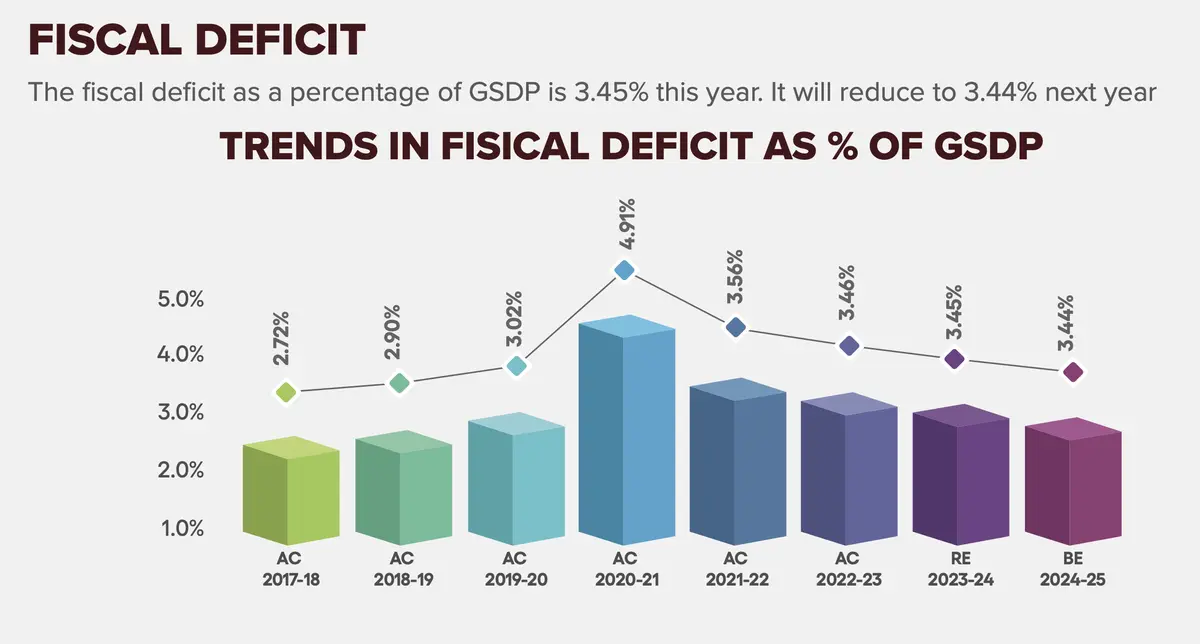
Tamil Nadu enters 2026 carrying significant fiscal pressure. Total state debt stands at approximately ₹7.5–8 lakh crore, with annual interest payments consuming nearly ₹55,000–60,000 crore, roughly 17–18% of total expenditure. The fiscal deficit has hovered near 3.0–3.5% of GSDP, breaching FRBM comfort zones in recent years.
Critically, capital expenditure like roads, ports, water, industrial parks has been progressively crowded out by rising revenue expenditure on subsidies and salaries. Tamil Nadu's capital outlay as a share of total spending has dropped from over 18% a decade ago to around 12–13% today. The state already allocates nearly 30% of its revenue expenditure to welfare transfers.
Can new schemes be funded without borrowing more? Mathematically: No. Not without either raising GST-linked revenues significantly, sharply curtailing existing expenditure, or accepting fiscal slippage. None of the five manifestos seriously address this trilemma.
REVENUE REALISM SCORECARD
The central question is not what parties promise to spend, it is whether they explain how they will earn.
- DMK references industrial investment targets (₹5 lakh crore over 5 years) and GCC expansion. Partially credible but lacks implementation detail.
- AIADMK references TIDCO-led industrial revitalisation. Vague on new revenue streams.
- BJP benefits from central scheme convergence (PM Awas, PM Kisan top-ups) that partially offsets state cost. Strongest on central transfer leverage.
- TVK proposes an ambitious coastal economy and tech sector plan with no costing framework.
- NTK proposes state-controlled essential goods distribution and alcohol prohibition the latter would eliminate Tamil Nadu's largest own-revenue source (TASMAC contributes ₹45,000–50,000 crore annually).
DEBT SUSTAINABILITY MODEL
If even 50% of manifesto promises are implemented by the winning party, Tamil Nadu's debt-to-GSDP ratio currently at approximately 28–30%, could rise to 34–38% within three years, based on standard fiscal multiplier assumptions.
Interest burden growth would accelerate beyond ₹70,000 crore annually by 2028–29, further crowding out productive expenditure. The welfare trap risk is real: once cash transfers and free goods schemes are inaugurated, political economy makes them nearly impossible to roll back.
Capital investment, the only route to sustained revenue growth would face the sharpest squeeze. Tamil Nadu risks following the Kerala model: high HDI, high debt, declining capital formation.
TRUTHMATTERS SCORE
Party | Financial Feasibility | Revenue Realism | Debt Sustainability | Administrative Practicality | Total /10 |
|---|---|---|---|---|---|
DMK | 5 | 5 | 4 | 6 | 5.0 |
AIADMK | 4 | 4 | 3.5 | 5 | 4.1 |
BJP | 5.5 | 6 | 5 | 6 | 5.6 |
TVK | 3 | 3.5 | 3 | 4 | 3.4 |
NTK | 2 | 2 | 2 | 3 | 2.3 |
Scoring is based purely on economic metrics , fiscal math, revenue credibility, debt trajectory, and delivery capacity.
RISK RANKING
Most Financially Realistic → Least Realistic:
- 🟢 BJP : Central scheme convergence reduces state fiscal load; more monetisable infrastructure promises.
- 🟡 DMK : Governing experience and bureaucratic continuity partially offset overreach.
- 🟡 AIADMK : High-promise, low-revenue framework; TASMAC dependence unaddressed.
- 🔴 TVK : Ambitious welfare architecture with no credible revenue scaffolding.
- 🔴 NTK : Ideologically coherent but economically unviable; TASMAC abolition alone creates a ₹50,000 crore hole.
FINAL ANALYTICAL VERDICT
Tamil Nadu is not a poor state, it is a fiscally stretched state. With a GSDP exceeding ₹26 lakh crore and a diversified tax base, it has genuine capacity. But that capacity is being systematically mortgaged by competitive welfarism without a compensating revenue strategy.
No manifesto in 2026 is fully financially sustainable. What separates the parties is the degree of fiscal irresponsibility, and whether any of them acknowledge the trade-offs.
The BJP manifesto, despite its political limitations in Tamil Nadu, is the most fiscally grounded primarily because it leans on central government co-financing. The DMK, as the incumbent, has demonstrated it can partially fund welfare without immediate collapse, though the debt trajectory is deteriorating. AIADMK replicates the high-spend model without fresh revenue ideas. TVK's manifesto is aspirational but economically adolescent. NTK would eliminate its own revenue base.
The honest conclusion, which no politician will state publicly is this: Tamil Nadu must choose between two futures. One where it becomes a high-welfare, high-debt state with stagnating capital infrastructure. Or one where it invests ruthlessly in productivity ports, manufacturing, skilling, digital infrastructure and earns the fiscal headroom to sustain welfare over a decade. Every manifesto offers the first path. None credibly charts the second.
Tamil Nadu's voters deserve to know that a free mixer-grinder is not free. Someone pays. And increasingly, that someone is the next generation.