


A deep analytical study of voter participation across five assembly elections tracing the arc from 70.82% in 2006 to a historic 84.87% in 2026, and what it means for democracy in India's most politically intense state.
Introduction
Democracy's Arithmetic: Numbers That Tell a Deeper Story
On April 23, 2026, Tamil Nadu scripted electoral history. With 84.87% voter turnout the highest recorded in the state since the first general election in 1952 the state defied both demographic headwinds and media cynicism to deliver one of the most emphatic mandates of democratic participation in Indian electoral history. Yet the number that defines this election is not the turnout percentage alone. It is the paradox that underlies it: Tamil Nadu had 67 lakh fewer registered voters in 2026 than in 2021, and still more people physically walked into polling booths.
To understand what this means statistically, politically, and sociologically one must trace the arc of turnout across five elections spanning two decades: 2006, 2011, 2016, 2021, and 2026. This is not a story of a single extraordinary election. It is a story of structural forces electoral roll revisions, multi-party competition, women's empowerment, and youth mobilisation colliding at a singular democratic moment.
84.87% 2026 Final Turnout | +11.24pp Rise vs 2021 | 4.87 Cr Votes Polled in 2026 |
Data Table
Five Elections, Five Portraits of Participation
Election Year | Registered Voters | Votes Polled | Turnout % | YoY Change |
|---|---|---|---|---|
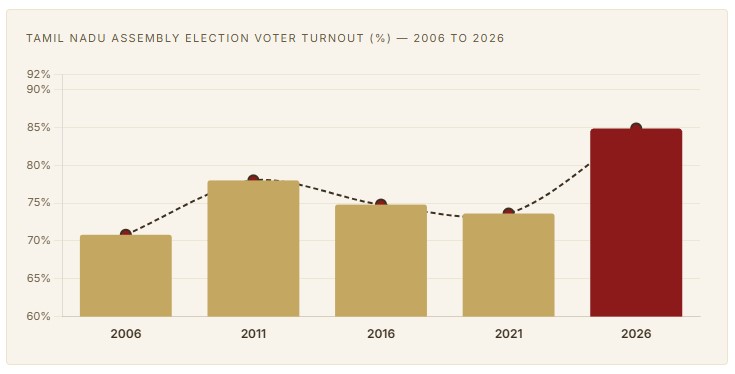
2006 | 4,66,03,352 | 3,30,05,492 | 70.82% | +11.75pp |
2011 | 4,71,15,846 | 3,67,56,813 | 78.01% | +7.19pp |
2016 | 5,77,91,397 | 4,32,34,665 | 74.81% | −3.20pp |
2021 | 6,29,43,693 | 4,63,44,590 | 73.63% | −1.18pp |
2026 ★ | 5,73,43,291 | 4,87,00,000 (est.) | 84.87% | +11.24pp |
★ 2026 figures: Official ECI data. Votes polled estimated from final turnout percentage. YoY change for 2006 computed against 2001 turnout of 59.07%. Source: Election Commission of India.
Trend Analysis
Reading the Curve: Twenty Years of Electoral Momentum
The turnout graph for Tamil Nadu from 2006 to 2026 is not a smooth upward line it is a parabolic curve of two peaks separated by a decade-long plateau of modest decline. The first peak arrived in 2011 at 78.01%, when an anti-incumbency wave against the AIADMK under M. Karunanidhi's DMK gave way to a galvanic public mood. The second and far higher peak has arrived in 2026 at 84.87%, under different but equally electric circumstances.
Between 2011 and 2021, Tamil Nadu experienced a decade of gradual erosion from 78.01% to 74.81% in 2016, then further to 73.63% in 2021. This plateau is not anomalous. Nationwide, Indian assembly elections have seen turnout stagnate in the mid-70s as voter fatigue, urban apathy, and increasingly bloated electoral rolls (artificially swelled by migration, delayed deletion of deceased voters, and demographic overcounting) suppress the percentage even when absolute voter numbers rise. In Tamil Nadu, the registered voter base swelled from 4.71 crore in 2011 to a peak of 6.29 crore in 2021 a 33.5% jump driven substantially by the addition of names that should not have been there.
"The electorate fell from 6.29 crore in 2021 to 5.73 crore in 2026, yet more people turned up to vote 4.87 crore against 4.63 crore a decisive proof that the surge is real, not merely arithmetical."— Data analysis, Election Commission of India rolls
Causes of Rise and Fall
The Six Forces That Moved the Needle
1. The SIR Effect: Electoral Roll Purification as Turnout Catalyst. The single most structurally significant factor in the 2026 surge is the Special Intensive Revision (SIR) exercise conducted by the Election Commission of India. Through this process, 97 lakh (9.7 million) names were deleted from Tamil Nadu's voter rolls on grounds of death, duplication, migration, and permanent relocation while 30 lakh new, verified voters were added. The net result: the electorate shrank by 67 lakh (10.45%). This is not a new phenomenon. Following SIR exercises in 2002 and 2005, approximately 8.75 lakh names were removed, contributing directly to the 11.75 percentage point jump from 59.07% in 2001 to 70.82% in 2006. History thus repeated itself with far greater force in 2026.
2. Women Voters: The Invisible Majority That Delivered. In 2026, Tamil Nadu registered 2.93 crore female voters against 2.83 crore male a reversal that reflects a decade of active enrolment drives and welfare consciousness. Women voters outnumbered men in 214 of 234 constituencies. Welfare schemes such as the Kalaignar Magalir Urimai Thogai (monthly financial assistance to women) created a direct, transactional bond between the ruling DMK and a majority of the electorate. Political analysts note that women-led welfare mobilisation correlates strongly with higher booth-level participation in rural and semi-urban constituencies.
3. Multi-Party Competition: The Vijay Factor. The entry of actor Vijay's Tamilaga Vettri Kazhagam (TVK), contesting solo across all 234 seats, transformed a traditional bipolar DMK–AIADMK contest into a multi-cornered battle. High-competition elections consistently produce higher turnout in Tamil Nadu a pattern traceable to 2006, when Vijayakant's DMDK first fractured bipolarity and nominations surged from 2,829 in 2001 to 3,902 in 2006. The 2026 election, featuring TVK, NTK, BJP, DMDK, and others in every constituency, maximised voter choice and intensified booth-level political activity.
4. Youth Voter Participation: First-Time Energy. The SIR exercise added 30 lakh new voters, disproportionately concentrated in the 18–25 age cohort. TVK's manifesto promising drug-free governance, startup loans, and collateral-free education loans targeted this demographic directly. Polling station observations across Chennai, Coimbatore, and Madurai noted longer queues of younger voters than in any previous cycle. Digital voter registration portals processed record new applications in 2025, suggesting that administrative accessibility contributed to youth enrolment.
5. Urban vs Rural Patterns. The 2026 election continued Tamil Nadu's defining pattern: rural and semi-urban districts voting at significantly higher rates than metropolitan Chennai. Karur led the state at 92.65%, followed by Salem, Namakkal, Erode, and Dharmapuri all agrarian interiors. Chennai, by contrast, recorded 81.34%, and Kanniyakumari a coastal, socially diverse district brought up the rear at 75.6%. Urban voter apathy, longer commutes, apartment-dwelling anonymity, and less intense party-booth penetration consistently suppress city turnout relative to the state average. Even so, Chennai's 81.34% in 2026 surpassed its own historical averages a sign that the political energy this cycle reached even the most apathetic precincts.
6. Media Narrative vs Statistical Reality. Pre-election media discourse focused heavily on voter list deletions, predicting suppressed turnout due to "disenfranchisement anxiety." The statistical reality contradicts this narrative emphatically. Across Tamil Nadu, the number of physical votes cast in 2026 (approximately 4.87 crore) exceeded the 2021 figure (4.63 crore) by 24 lakh absolute growth, not just percentage arithmetic. The SIR, rather than suppressing participation, removed ghost voters and produced a cleaner, more energised electorate.
Current Scenario
The 2026 Mandate: Real Surge, Not Statistical Illusion
The question that political scientists and opposition analysts have raised whether the 2026 turnout spike reflects a genuine voter surge or a mathematical mirage produced by roll shrinkage is settled by one data point: more voters cast their ballots in absolute terms than in 2021. The denominator (registered voters) shrank, but the numerator (votes polled) grew. This is a double confirmation of genuine public engagement, not a statistical artefact.
District-level analysis reinforces this conclusion. Every district in Tamil Nadu recorded a higher turnout percentage than in 2021. The variance between the highest (Karur at 92.65%) and lowest (Kanniyakumari at 75.6%) narrows considerably compared to the 2016 and 2021 cycles, suggesting a broadly uniform upsurge rather than concentrated pockets of enthusiasm.
Future Outlook
What 2026 Predicts for Tamil Nadu's Electoral Future
The 2026 election likely represents a new baseline, not a temporary peak. Three structural factors will sustain elevated turnout in future cycles. First, the SIR template, if applied rigorously before each election, will prevent the register bloat that artificially suppresses percentages. Second, women's electoral dominance both in registration and in physical participation is now a demographic fixture, not a campaign-cycle anomaly. Third, competitive multi-party politics, with TVK establishing booth-level infrastructure across all 234 constituencies, ensures that future elections remain intensely fought at the grassroots level.
The 75–78% range that defined 2016–2021 is unlikely to return as the Tamil Nadu norm. If clean electoral rolls and sustained political mobilisation persist, the state appears on a trajectory toward a structural turnout band of 80–86% in future assembly elections a level historically associated only with exceptional singular contests. Tamil Nadu may have made the exceptional the ordinary.
Conclusion
Democracy Did Not Just Survive: It Accelerated
The story of Tamil Nadu's voter turnout between 2006 and 2026 is ultimately not a story of statistics. It is a story of an electorate that has despite political disappointments, welfare fatigue, migration pressures, and urban alienation consistently renewed its faith in the act of voting. The 2026 figure of 84.87% is the highest since the state's first assembly election. It is also, in the most precise sense, earned: earned by the Election Commission's administrative courage to purge ghost voters, by welfare programmes that gave women a concrete stake in political outcomes, and by a new generation of voters who saw in this election not a repetition of the past, but a genuine contest for the future.
The paradox with which we began more votes cast from fewer voters resolves itself into a straightforward democratic truth: when the electorate is real and the contest is genuine, people vote. Tamil Nadu proved that in 2026 with 84.87% certainty.